Tuesday, December 06, 2011

Recipe: Lemon Rhubarb Cake


I'm not going to moan on about work again, I promise, but what does it say that as the early days of winter darken, I am *finally* posting the last of the rhubarb series, which I made into a lemon rhubarb cake.


After looking out for it this year, I realized that one can find rhubarb in Singapore after all, it is sometimes available at Cold Storage and Jason's, however, it is not fresh, turgid and thick like in England but a rather sad, scrawny version.


I just used a simple lemon Cake Recipe, from the Barefoot Contessa Ina Garton's Party Ideas and added the chunks of rhubarb to the batter before baking. I also like to replace 1/2 a cup of flour with ground almonds (or hazlenut/almond mix, leftover from macaron baking) and I added another contraband, poppy seeds.

226.8g unsalted butter (room temp)
2 1/2 C granulated sugar
4 extra-large eggs (room temp)
1/3 C grated lemon zest (6-8 lemons)
3 C all-purpose flour
1/2 tsp baking powder
1/2 tsp baking soda
1 tsp kosher salt
3/4 C lemon juice
3/4 C buttermilk, room temp
1 tsp pure vanilla extract

1. Preheat oven to 350°F (175°C)
2. Cream butter and 2 C sugar, add eggs
3. Add lemon zest
4. Sift flour, baking powder, baking soda, and salt.
5. Combine 1/4 cup lemon juice, buttermilk, and vanilla.
6. Alternate flour and buttermilk, begin and end with flour
7. Bake 1.5 hour
8. Pook holes all over cake. Cook remaining sugar with lemon juice and pour over if desired, if not, sprinkle lemon juice over cake while it is baking.


Tha family ate this one up and I really savoured the mixture of the citrus kick with the slight vegetal bitterness of the rhubarb. Till next year, my beauties!

Miscellaneous Food: 10 Souvenirs from Paris

While we usually don't reprint content, this list by David Leibovitz was just too brilliant not to share. The original article can be found on his intelligent, educational bloghere.

"In the reverse direction, outside of France you’ll often pay hefty prices on French-made items; certain goods one can buy in France quite cheaply. Of course, shipping, exchange rates, taxes, and other costs figure in to those prices when you see them in a store in New York City, but if you’re coming to France, here’s a few things you might want to check out. I didn’t include things like chocolates, macarons, or other obvious things simply because, well, they’re pretty obvious.

For bringing stuff back, although you can buy zip-top freezer bags in French supermarkets, the very heavy ones aren’t available, so you might want to bring a few from home for securing whatever you schlep. Bubble wrap and packing tape are not easily available, so you might want to pack a few sheets along and a small roll of tape if you plan on buying things in glass jars to carry home. I slip small jars into socks then put them into shoes in my suitcase, which cushions and protects breakables.

Wine and some cookware are cheaper in Paris, but they’re hard to carry, especially with luggage restrictions. Certain French companies manufacture their cookware in Asia so it’s not always a bargain to buy it France. (Plus you always pay a 19.6% tax on all purchases in France.) If you’re a wine or absinthe collector, perhaps it’s worth carrying bottles back; La Poste sells boxes specifically for shipping wine, with Styrofoam inserts for two bottles.

The rules are constantly changing about what you can and can’t bring back to your home country. So it’s always best to check the website of your government customs agency for the latest information. Few countries allow fresh fruits, vegetables, or meats to be brought in from other countries unless they’ve been heat-treated, which means sealed in a can. Jars are iffy and are sometimes confiscated.

At present, you can’t bring things like mustard or jam on the plane, and I’ve heard third-hand accounts of chocolates from La Maison du Chocolat and Ladurée macarons being taken away at security. The rumor is that they know what boxes to look for, take them away, and then eat them.

1. Mustard: I like Edmond Fallot mustard quite a bit (you can find it at swanky prices in gourmet stores like La Grand Épicerie, or at normal prices at G. Detou), although when I first moved to France, I had my groceries in a sack coming home from the supermarket, and I had a giant jar (think a quart) of Amora mustard in there, since it was so inexpensive. A woman sitting next to me, said, “Très bon…et très forte!” (“Very good…and very strong!”) If you don’t want to mess with jars, mustard is also sold in plastic squeeze bottles as well.

(And although I’ve never tried it, I know folks addicted to Savora, a spiced mustard-based spread from the same company. It fetches very high prices in the states, no doubt because folks are accro, or ‘hooked’. Which may be the reason I have yet to taste it.)

2. Salt: I’m a salt chauvinist and although it sounds elitist and annoying, I really do use exclusively French salt. And that’s not just because I live in France. I get salt whenever I travel. But no matter how many little bowls of white, gray, and whatever-colored crystals are lined up on my counter top, I always reach for the little bowl of French salt first.

The last few years, fleur de sel de Guérande has been in short supply because of untimely rains, when the salt was supposed to be harvested. But you can find it in certain shops and markets, as well as its cousins, fleur de sel de Noirmoutier, Île de Ré, and from the Camargue. Depending on where you shop, and the provenance, a 125g (4 ounce) container costs between €3-€5 in France. The price is about double elsewhere. Coarse gray salt is a bargain in France, too, and just about every supermarket sells it for roughly €1.25-€1.50 for a 500g (about a half pound) bag. I buy it and grind it myself in a blender or mortar and pestle, and use it for cooking and baking.

3. Biogaze: When I worked in the restaurant business in San Francisco, I worked with quite a few French people. And in the restaurant business, as you can imagine, there were quite a few burns. After one of my French co-workers took a trip back to France, he returned with several packs of Biogaze, saying it was great for treating superficial minor burns. And sure enough, these pre-moistened layers of gauze are great for kitchen brush-ups with heat. A pack of ten costs approximately €9 and you can ask for them at any pharmacy.

4. La Roche-Posay Sunscreen: For many years, the FDA would not allow these amazing sunscreens to be sold over-the-counter in the US. But I saw them on shelves on my last visit, selling for a whopping $29, plus tax. In France, my favorite sunscreen is the Anthelios XL (the ‘fluide’ one is for the face; the others are thicker lotions) and costs about €11. It’s extremely liquidy and feels like water going on, so there’s no gunky, creamy feeling meaning that you can wear it without feeling like you’ve got a layer of pastry cream on your face. Depending on the season, stores like Parashop, which are all over Paris, often discount it or put it en promotion.

(Note that a parapharmacie sells cosmetics but not remedies or pills or drugs. Regular pharmacies do fill prescriptions, as well as carry cosmetics. In France, over-the-counter drugs are, indeed, sold over the counter. So although you might not see them on the shelves, you can purchase some things, like Biogaze, without a prescription.)

5. Lentils from Puy: Until regular lentils, these compact, sharp-edged lentils are grown in volcanic soil and allowed to dry on the stalk. Their terroir gives them a minerally flavor. But what’s even nicer is that they don’t turn to mush when you cook them. About 25 minutes in boiling water with an onion half, a bay leave, some thyme, and maybe a few chunks of bacon. Drain, season, and serve. Or add tiny cubes of cooked carrots, celery, and fennel, let cool, and toss in some crumbled goat cheese and nuts—voilà, the perfect side dish or lunch in about half and hour. I always keep a bag on hand and they’re about one-quarter of the price in France than they are outside of France. Most well-stocked supermarkets sell green lentils and although you can find regular green lentils easily, if you see the lentilles de Puy, grab those.

6. Kitchen Gadgets: Although large cookware is unwieldy and not always a bargain in France, small gadgets and paring knives, especially those made in France, are. Outdoor markets always have stalls of people selling everything from Opinel knives to little tartlet molds. Yes, you can buy them at the specialty shops around Les Halles, but they’re not selling madeleine molds for €2 or wooden-handled Nogent paring knives for €5.

If you’re not able to hit the market, La Vaissellerie, which has shops all over Paris, also has quite a few kitchen gadgets available inexpensively.

(Tip: The cutlery with the bee or fly on the handle may be labeled Laguiole, but is not the authentic, high-quality cutlery from that region. The name was never trademarked and a real Laguiole knife will not cost less than €50. Two reputable makers of Laguiole cutlery are Forge de Laguiole and Laguiole en Aubrac, among others.)

7. Christine Ferber Jam: Every American I know goes nuts over these jams and jellies from the famed Alsatian jam-maker Christine Ferber. I make my own, and as much as people want to quiz me about which one to buy, I’ve only tried one or two…but her flavors sure look tempting. And I know many a folk who’ve returned home from their trip with a lone jar, who write frantically wondering where they can get more in America. (You can’t.) The best selection is at La Grand Épicerie, however Da Rosa sells them as well, although they’re a few more euros per jar.

8. Salted Butter: Really great salted butter is available in every French supermarket (Tip: Look for one with a blue and white label and aux cristaux de sel de mer, or ‘with sea salt crystals’) and if your home country allows it, you can bring back blocks of this butter and store it in your home freezer for months. If traveling during non-summer months, I put blocks in zip-top bags and bring them to friends, too. Most butter will survive a several hour trip just fine, but if you bring an insulated freezer bag and ‘ice bricks’ (ask a friend or your hotel to chill it overnight) over with you, you can make good use of them on the return trip.

If you want to bring back top-quality French butter, you can buy Bordier butter at La Grand Épicerie, Da Rosa and Breizh Café or Pascal Bellevaire butter, which is pretty great too, at any of their fromageries or La Grand Épicerie.

9. Speculoos Cream: I lugged a few jars of this spread back to the states to friends, and I got notes in my Inbox with expletives from them a few days later, saying I’ve ruined them for life. This gingersnap-like Speculoos cream is a bit of sweet-spicy heaven in a jar. It’s just a few euros in most supermarkets and can be found in the same aisle with the jams and chocolate-hazelnut spreads.

10. Valrhona Cocoa Powder: I hesitate to call for specific brands in recipes when I’m writing them up because 1) it’s frustrating when you want to make a cake and you need to mail-order for something, and 2), Not everyone can afford the same swanky products. However I do find that this French-made cocoa powder is much darker and more flavorful than any other and because it makes such a difference, I’ve found that the results are dramatically different (ie: less intense) if made without it. If you’re a dedicated home baker, you can buy a 3 kilo (6 1/2 pounds) of this cocoa powder at G. Detou for around €35. It’ll keep for a few years in your pantry because it’s packed in air- and light-tight bags. If you’re not a dedicated baker, you’ll be happy to know that it comes packed in three individual bags, so you can split the booty with friends.

Bonus #11: Hazelnut Praline Paste—I had to add this one at the last minute because I brought some American friends into the shop of John-Charles Rochoux last week and after they were done swooning over the tiny spoonful offered, they picked up four jars of this spread made of darkly caramelized hazelnuts, using fresh nuts of the highest quality, then ground to a smooth paste. Words can’t describe how good this tastes—just make sure not to put the it in your carry-on: it’d be a shame if the customs officers got to enjoy it, instead of you."

Monday, November 07, 2011

Recipe: Salmon Fishcakes


Sometimes food doesn't have to be complex. Sometimes it can be really, really simple. Like this recipe for salmon fishcakes, which I got from a South African colleague. He reminisced about growing up in a community where there wasn't a lot of refrigeration, so his mother depended on tinned food to feed him as a young boy.


These are really simple to make, you can use tins of red salmon but you can also add fresh fish to them, or even chunks of scallop or crab and mashed potato, red scallions and capers, if you're feeling fancy. They taste best when they are served piping hot!

Ingredients:
(Serves 6)
1 can or 16 ounces red salmon
1 small onion, finely chopped
2 tablespoons minced fresh parsley or cilantro
ground black pepper, to taste
2 large eggs, well beaten
1 cup fine dry bread crumbs
3 tablespoons butter
1/2 cup of vegetable or flavourless oil
5 tablespoons flour
juice of a lemon

Method:
1. Turn salmon and liquid into a medium mixing bowl. Flake with a fork, removing or mashing any bones (they are edible).
2. Mix in chopped onion, parsley and pepper.
3. Mix beaten eggs with salmon. Add enough bread crumbs, about 1/2 to 3/4 cup, to make thick enough to shape into 12 small patties.
4. Roll patties in flour. I found it easiest to shape them (I prefer mine small and bite-sized), then drizzle and pat dry flour onto the patties, taking care to fry them before they became wet again.
5. In a large heavy skillet over low heat, melt 2 tablespoons of butter with 1/2 cup of oil; add patties.
6. Fry patties slowly on one side; turn patties and fry until brown on the other side. Some people prefer to pan-fry the patties with just the oil, I find this presents a problem with making the patties stick but it's probably healthier.
7. Serve with ketchup, cilantro chiffonade and a squeeze of lemon.

* Thank you to M. for the gorgeous photographs!

Sunday, October 02, 2011

Review: Keystone Restaurant


Whoever owns Keystone Restaurant really has a thing for rocks. "By its nature, a Keystone is an architectural feature, which... encompasses strength and resilience, and its mighty characteristics make it the most integral part of every structure", the restaurant's website declares.


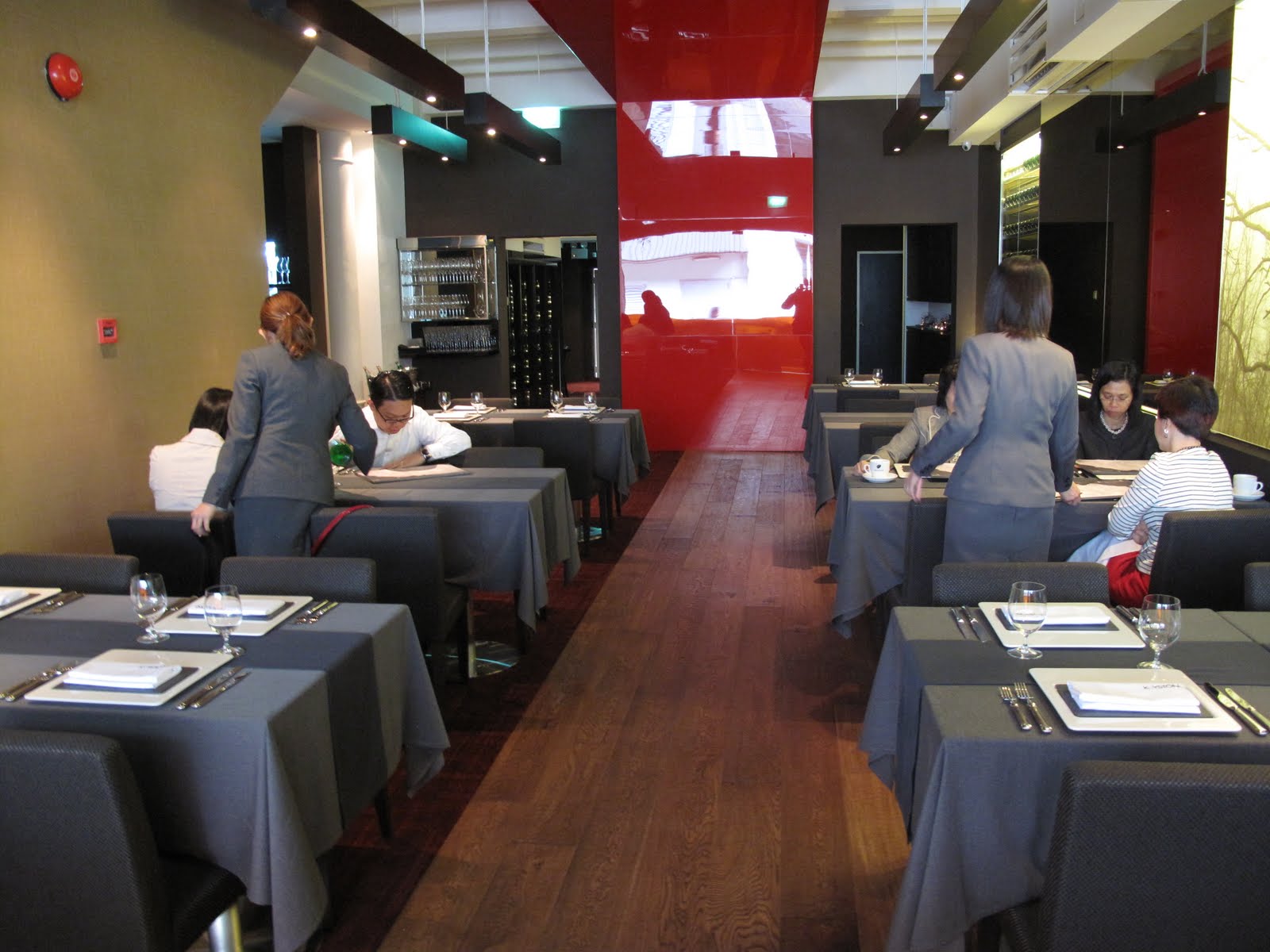
Fair enough, I suppose, but it's only if we remember that "keystone" also describes a type of limestone does that explain why all the tables are set with grey and black tablecloths, or why the waitresses are all kitted out in ashen suits, and why the plates have slate inlays.


Even the bread, it would appear, is in theme. Not that I'm complaining; the jet black sphere of focaccia bread, dyed with (I think) squid ink, is served piping hot, and when broken open exudes a lovely aroma of rosemary and olives. I'm not usually impressed by bread at restaurants, but I must say this was excellent.


The restaurant considers itself modern European, which unfortunately means a penchant for the menu to describe everything in only proper nouns ("Pistachio & Peanut Butter | Custard | Brittle | Chocolate Pool"), but, more positively, also a willingness to explore different flavour and texture combinations, such as an amuse-bouche of toasted tomato crostini with bone marrow, which was both crunchy and unctuous.


Modern European doesn't necessarily mean a lack of Asian flavours though, as the lobster and ginger consomme demonstrates. The broth, perhaps darker than I would have imagined, carries with a subtle heat and the distinctive taste of the ginger rhizome, while the supple ravioli enfolds the lobster meat like an upmarket shrimp wanton.


A starter entitled "Shimeji and Shiitake" was not exactly what I had expected, for I had envisioned the mushrooms being the main event, but it turned out that "Baby Spinach | Asparagus | Fennel | White Truffle Emulsion" meant the dish was in fact a baby spinach salad with mushrooms. Still, the delicate nuttiness of the spinach leaves, together with the earthy mushrooms, and what appeared to be pine nuts rather than fennel seeds, made for a fairly enjoyable salad.


The petite portions of the appetisers are misleading, however, as the main courses soon revealed. The sous vide Norwegian salmon, glazed with kome migu miso, is enormous, and a generous bedding of julienned sugar peas ensures that there's always something to go with it. Sous vide is a marvellous way of cooking a fatty fish like salmon, for it ensures that the salmon does not become tough and leathery, but instead retains its oleaginous mouthfeel and beautiful colour.


Unfortunately, sous vide technology was not entirely sufficient to prevent my La Sirena chicken breast from drying out slightly (as far as I'm concerned no Western chicken breast can beat a properly-prepared Hainanese chicken rice breast), though it was a valiant effort, and with a sauce of melted Gruyere cheese, it was easily overlooked.


The desserts at Keystone are, perhaps, the keystone, for the passionfruit cake was the perfect combination of light, fluffy coconut sponge and sweet passionfruit sorbet, served with an intense raspberry sauce to counterbalance the sugar content.


The valrhona fondant I had was a thing of beauty - having baked these things myself, I know how difficult it is to make them appear attractive, but Keystone's version was perfectly formed, without any hint of cocoa dusting or any of the other common imperfections. Served with a sudachi (a Japanese citrus fruit) sorbet, and with peach spheres (really they were globules rather than true spheres), I could think of no better way to end the meal.

Food at Keystone certainly does not disappoint, but at $38 for three courses and coffee, Keystone's set lunch seems somewhat steep to me, especially for a relative newcomer located in Stanley Street, which is its biggest drawback, for it is impossible to find a parking lot at lunchtime. Perhaps it would do well to remember that a "keystone" species is also one that has a disproportionately significant effect on its environment, and if Keystone Restaurant aspires to that position, there is still some evolution in its future.


Keystone Restaurant
11 Stanley Street
Tel: +65 6221 0046
Website

Monday, September 19, 2011

Miscellaneous Food: Pierre Herme's Macaron Cookbook


This week, I celebrated the launch of the Pierre Herme book in English in a big way by baking with C. and K. of MadBaker fame. I picked the two flavours that had the biggest impact on me when I tried them in Paris, Jasmine and Olive Oil. These were flavours that both my baking buddies had never considered but they gamely agreed to have them a go. K was even gracious enough to lend her gorgeous photographs to the occasion, please visit her blog for more beautiful macaron creations here

The session was relatively without incident. Clearly, the baking gods were smiling down upon us, even with white chocolate recipes that are prone to seizing up. The Italian meringue recipe for the shells is not different to what I usually use, only the addition of colouring surprised me- there is quite a lot of colouring added and it makes the batter somewhat softer than I am accustomed to.

For the first recipe, we steeped jasmine tea in cream, which was then added to the melted white chocolate. K's concern was the too-high proportion of liquid to solids in Pierre Herme's ganache recipes, which is something that has been brought up before. Mine was the amount of tea used, I knew from my experience with Darjeeling tea tarts that a copious and wasteful amount of tea must be used to extract flavour in cream or custards. The recipe called for just 25g of tea, which seemed improbable, given that we were then diluting it with a far more flavourful white chocolate.

Both concerns as it turned out, were accurate, we reduced the cream:solids ratio to 1:1 for the jasmine recipe which worked out well but the flavour was still weak and like the earlier Earl Grey macarons, dissapated fairly quickly. In his footnote, Pierre Herme says he uses Sambac jasmine essence for this macaron, which is definitely something I would consider if I made this again.

The book, I concluded, is quite a fascinating read about all the different flavours, sorted in buckets like staples and then "fetish" flavours. Some of the photography is just beautiful and breath-taking, for example, the pure-white Alba truffle macaron, which is shot against a panel of mirrored glass, or the ostraica caviar macaron, sitting amonst jet black caviar in a vat of dark lilac ice cubes. However, some of the photography shows smashed macarons and collapsed interiors.

There are also some inexcusable errors in the book, which really should have been spotted by the copy editor and which leads me to suspect that there wasn't a recipe tester. For example, in the carrot macaron recipe, the ingredients list excludes the chocolate ganache, while the method includes it. For the Milk Chocolate and Earl Grey Tea Macaron, the ingredients list includes 12g cocao pate but nowhere in the method does the ingredient appear.


For the olive oil macarons, we used a strong, fruity Provence oil from A L'Olivier, which wound up being somewhat too strong. I was looking for the greenest Italian olive oil, thinking this would have the strongest flavour but we would have been better off with a young but fruity French olive oil. If you are going to try the recipe, I would strongly advise using a single vineyard oil, I've bought one before from a Parisien farmer's market that would have been perfect for this purpose.

We emulsified the oil into the ganache, which formed a fragrant, smooth paste, then loaded the inside of the macaron with diced Sicilian green olives that had been washed of their brine. These Silician olives are darker green, larger and sturdier then the regular Greek Kalamata olives and they are fantastic, turgid and chewy, with a real salty kick.

K. did most of the heavy lifting of sifting and macronage for these, while C. and I got to do the fun parts, like slicing, piping, matching and filling. I stacked them with dark chocolate ganache macarons in assortment boxes and overall, I'm really happy with the way the recipes turned out, even if we probably will move on to the more conservative flavours!

* Having now made some additional flavours, I realize that there is two added issues- first, the addition of colouring to the egg white tends to make the shells soft and wet. Also, some recipes call for compotes which are frozen into jellies (like in the Arabella macaron), without gelatin. These frozen jellies are then sandwiched within the ganache but when they start to melt, they also make the macarons shells wet and soft.