Tuesday, May 11, 2010

Recipe: Mentaiko Pasta


My sister has posted an earlier recipe for mentaiko pasta, but I thought I'd share my version, which is less rich and more similar to carbonara. Since it's called mentaiko pasta, you can conceivably use any type of pasta, though I feel that noodles like spaghettini or linguini are preferable to pasta like fusilli. The Japanese ingredients are available in most good supermarkets, as well as those that have dedicated Japanese sections like Cold Storage Takashimaya, Meidi-Ya and Isetan.

Mentaiko Pasta (Serves 2)
200g pasta
2 sacs of mentaiko
100g shimeji mushrooms
1 Tbsp of minced garlic
1 Tbsp Japanese mayonnaise
1 Tbsp sake
1 Tbsp rice vinegar
1 tsp mirin
1 egg
Olive oil
Tobiko and cilantro to garnish


Boil up some salted water in which to cook your pasta. While the water is boiling, crack the egg into a bowl and whisk with a fork till the egg white is farily incorporated into the yolk.


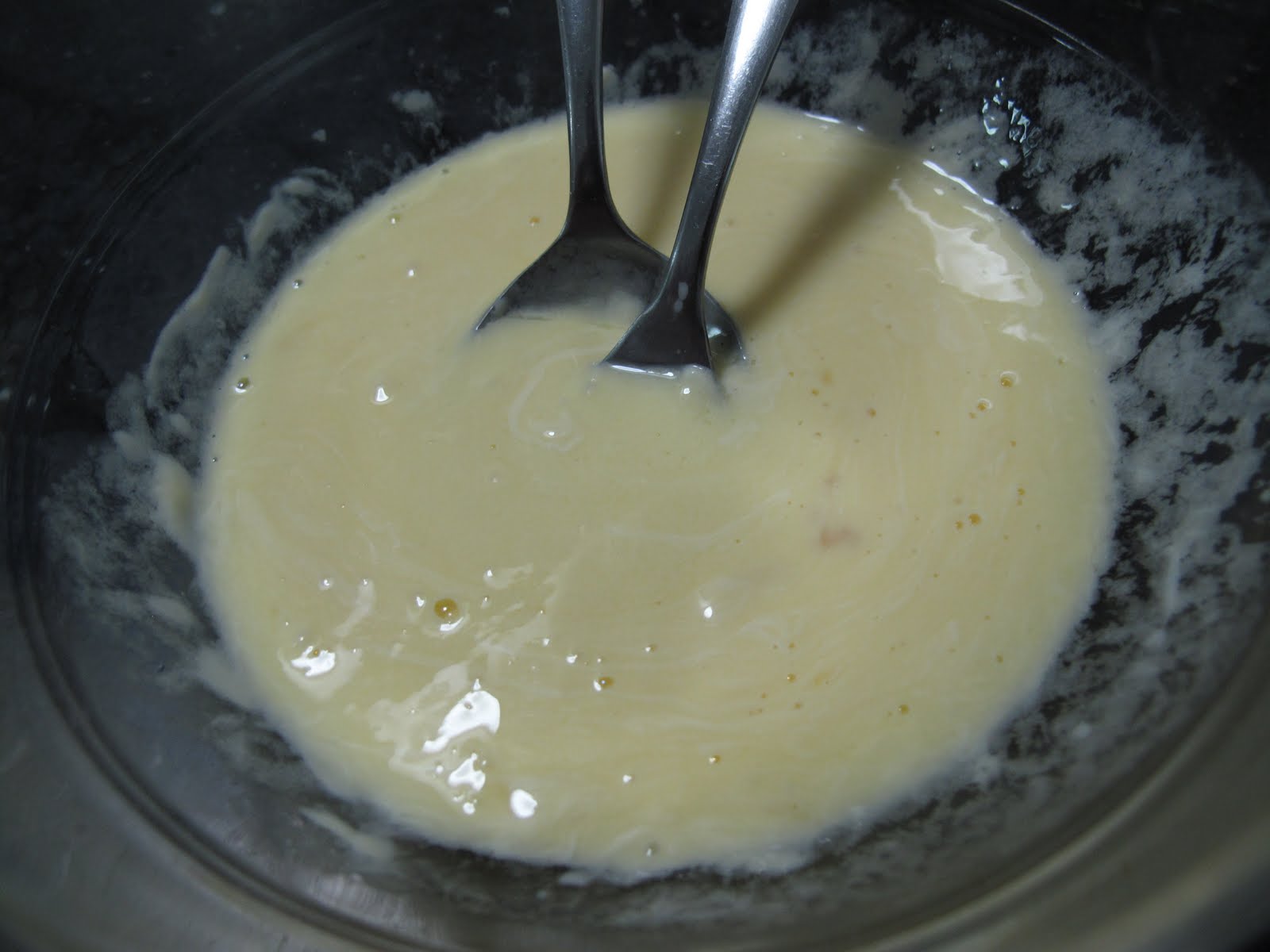
Add the Japanese mayonnaise, sake, vinegar and mirin, and gently stir until all the liquids homogenise and you obtain a fairly smooth, milky liquid.


Using a knife, slit open the sacs of mentaiko and scrape out the roe with the back of the knife, dropping the red fish eggs into the bowl containing your egg-mayonnaise-vinegar-sake-mirin mixture.


Gently stir the mixture with a fork in order to incorporate the roe and create a thick suspension. Do not whip the mixture vigorously as you might cause the tiny eggs to burst.

At this point, the pot of salted water should be boiling, and you can add the pasta. Since the preparation of the mentaiko sauce takes less than 5 minutes (on a gas stove; if you're using an electric hob it might take considerably longer), you should start cooking it when your pasta is about 3 or 4 minutes away from being done.


Heat up the olive oil in a saucepan or frying pan, and add the minced garlic. Lightly fry till the garlic is golden and shimmering, but not browned.


Add the mushrooms and fry these too. Shimeji mushrooms don't require much cooking, so be careful not to overcook them - they only need half a minute or so.


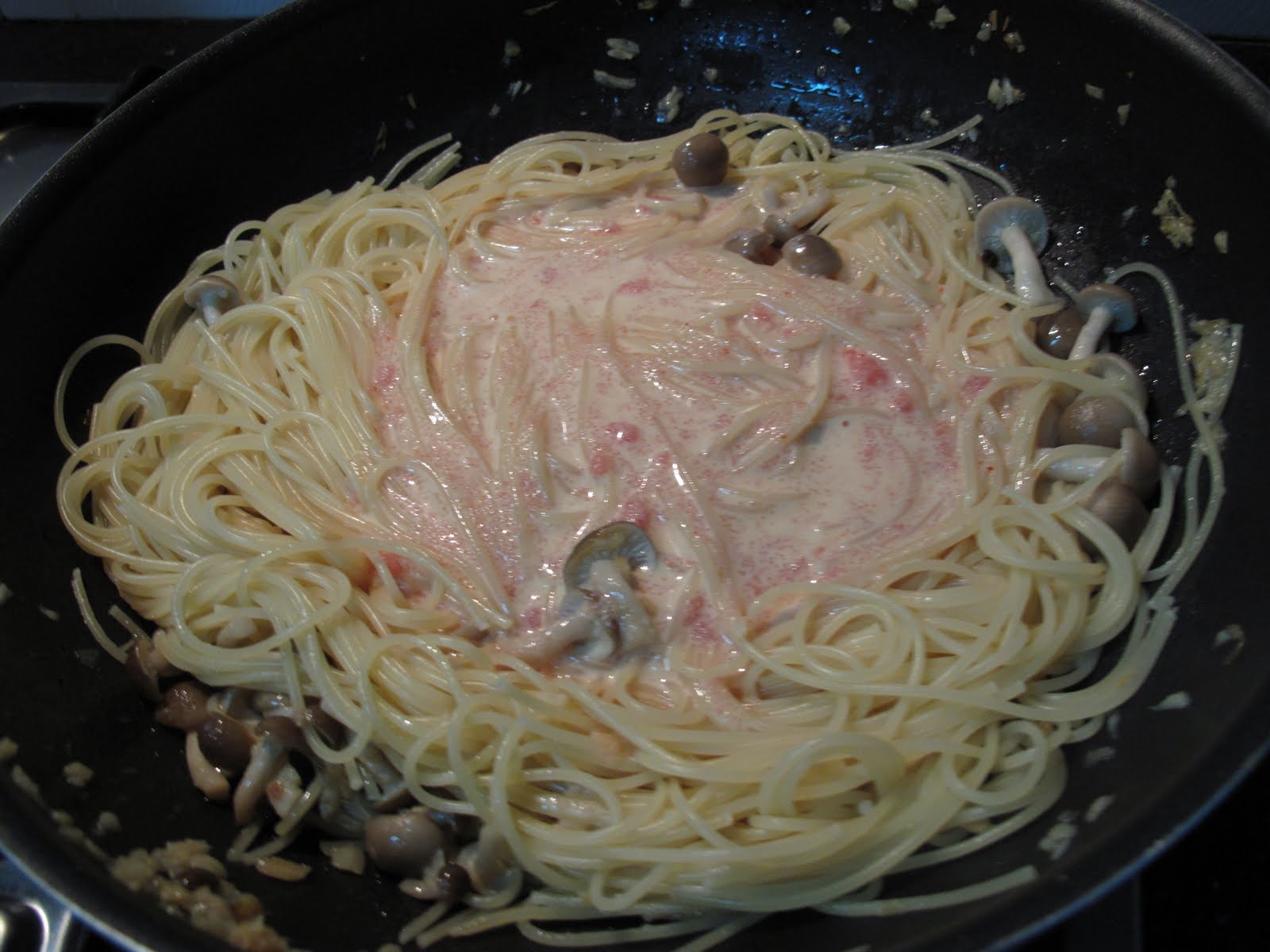
By now the pasta should be almost cooked (you're aiming to undercook it and finish it in the pan, so it shouldn't even be exactly al dente). If it's still not quite done, you can take the saucepan off the heat till the pasta is ready. Once the pasta is ready, either strain it in a colander or using a pasta spoon and add it to the pan with the garlic and mushrooms.


Taking the saucepan off the heat, pour in the bowl of mentaiko sauce, and the residual heat of the pasta will cook it without curdling the eggs. Mix or toss the pasta in the pan to ensure that all the noodle strands are evenly coated.


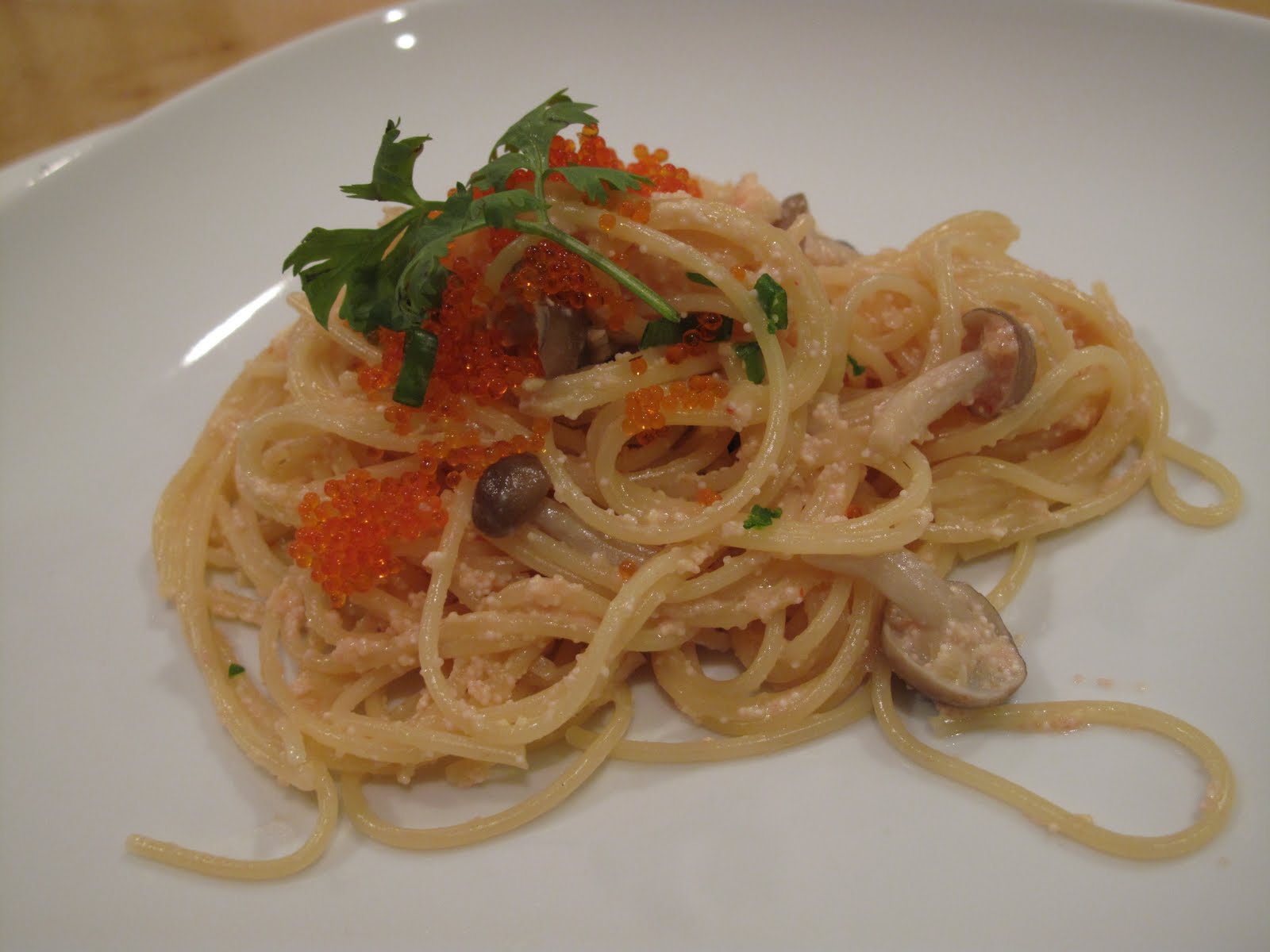
Plate up, garnish with a small pinch of tobiko and a sprig or two of cilantro, and enjoy immediately.

Sunday, May 09, 2010

Review: Candlenut Kitchen

I don't believe there have been any reviews of Peranakan restaurants on this blog, but we decided to go to Candlenut Kitchen after Chubby Hubby introduced and reviewed the place here. Check out the link for the interesting backstory about Chef Malcolm Lee and the genesis of the restaurant.


For those who want a quick introduction, Candlenut Kitchen is a fairly new restaurant along Neil Road serving traditional Peranakan cuisine in air-conditioned comfort. Nyonya food, despite its deceptive homeliness, is not at all easy to cook, being extremely labour-intensive, which may explain why there are relatively few Peranakan restaurants in Singapore. Candlenut Kitchen aims to bring the same sort of love and devotion to the preparation, cooking and serving of Peranakan food that Straits Chinese matriarchs would have expected or demanded from new daughters-in-law.

The restaurant is not very large, accommodating about thirty people, but when I was there on a Monday evening the restaurant was almost full: a good sign, and probably attributable, among other things, to Chubby Hubby's positive remarks. A quick sampling of other food blog reviews though, seems to indicate that diners so far have had a favourable impression. Of course, it helps that the prices aren't exorbitant - dinner came up to about $25 per person.


Candlenut Kitchen does not have a very extensive menu, so chances are most people will end up having the same dishes, which is not necessarily a bad thing, considering that certain dishes simply spring to mind when you think of Nyonya cuisine. Like kueh pai tee, for instance. Although the pastry shell could have been crispier, the consensus was that the filling was excellent, as the natural sweetness of the turnip was immediately evident, and the filling itself was nicely moist without being wet.


I'm not entirely sure what makes a good chap chye, since it's essentially stewed vegetables. In fact, I'm not even sure what goes into chap chye, or how it's made, so that leaves me rather unqualified to comment.


Ayam buah keluak is a rich curry containing chicken and the eponymous buah keluak, which is a nut or seed from the kepayang tree (pangium edule) and is, as wikipedia explains, deadly poisonous without the right preparation. In any event, Candlenut Kitchen's ayam buah keluak is not poisonous, but delicious: the chicken is meltingly tender without being overcooked, and the sauce is lip-smackingly good, with a slightly sour tang that enlivens the curry.


Sambal is the spicy hallmark of many South-East Asian cuisines, and it features heavily in Nyonya food. At Candlenut Kitchen, sambal petai, a hot concoction of red chillis, garlic, shallots and petai beans is served with prawns - a fairly classic combination. Avoid the petai beans if you are not a fan of strong-smelling foods (they are also known as "stinky" beans), as the sambal is piquant enough to stand on its own.


The great thing about eating ethnic food is that the research after is almost as enjoyable as the food itself. Ngor hiang for instance, a sausage-like thing that consists of a meaty filling wrapped in a fried beancurd skin, seems to be more a Hokkien dish than a Peranakan one, but understandably with much cross-pollination between the Malay and Chinese communities, it is unsurprising that neither ethnic/racial group can lay absolute claim to a dish as their peculiar heritage.


Candlenut Kitchen serves two different types of curry (not including the ayam buah keluak): the traditional chicken curry, and a "Yeye's curry", a thick, almost creamy, white pepper-based curry that is evidently a family recipe. Adorned with lime leaves, this white curry tastes (and looks) like a Thai green chicken curry, which is perhaps why I think I would have preferred the traditional orange chicken curry.


Every cuisine seems to have its own version of pork belly, my sister commented over a meal at Spice Peranakan (more on that in a later post), and babi garam assam is a pork belly simmered in tamarind, before being thinly sliced and seared over a hot pan. Candlenut's version was generously doused with sauce, though, which attenuated the desired charring somewhat.


Sotong sambal is another Peranakan classic, and the one we had was very deftly handled. The sambal was not extremely spicey, which was fine by me, but the squid was cooked just right, retaining its firmness at first bite, which then gives way to a delicate chewiness that is not marred by any rubbery texture.


The desserts at Candlenut Kitchen are also very enticing. The banana cake, served with vanilla ice cream, is redolent with the scent and taste of ripe bananas, and suitably moist that you don't even notice when you're halfway through one.


Thus far all the food has been eminently traditional, and what you'd expect if someone invited you to their house for a home-cooked meal of Nyonya food - Chef Malcolm is clearly not aiming to reinvent Peranakan cuisine. The only exception, however, is the chendol cream, which is basically a deconstructed version of chendol, involving a coconut milk pudding, that's topped with gula melaka (brown palm sugar syrup) and pandan noodles. While unpopular with chendol purists like my father, I found this to be the best dish of the night, partially because these are the ingredients of chendol I like most anyway (not including attap seeds). As a matter of culinary experimentation, too, the chendol cream is a success: the fragrance of the coconut cream is rich and powerful, but rounded off by the butterscotch-caramel flavours of the gula melaka, which provides a great colour contrast that is further enhanced by the bright green chendol "worms".

Candlenut Kitchen is just starting out and making a name for itself, and is a welcome addition to the food scene in Tanjong Pagar. It offers a great set lunch at only $10, and is of course a good venue for communal dining.

Candlenut Kitchen
25 Neil Road
Tel: +65 6226 2506
Website
Email
Opening Hours: Monday to Saturday 1130 am - 3pm and 6pm - 1030 pm (Closed on Sunday + Public Holidays)

Tuesday, March 30, 2010

Review: The Dunearn

Apologies in advance for the poor photographs: I didn't have a good camera with me.

The Dunearn is a fairly young, modern European restaurant that opened in July 2009, and is located in the Guild Hall of the NUSS Graduate Club, at the Bukit Timah Campus (i.e. the Law Faculty of NUS). The food is pretty good, portions are fairly generous, service is decent and prices are low... what's not to like?

A smorgasbord of menus is available to selection here: you could have the 5-course executive set dinner for $40, or a 3-course, 4-course, or 5-course dinner (where you can choose anything on the menu) for $50, $60 or $70 respectively, or you could limit yourself to an a la carte option. I've ordered the 3-course menu twice, and I also watched as some friends devoured the executive set dinner.


The Dunearn is not a very large restaurant, so reservations are a must, especially on weekends. Due to its size, it does become a little noisy as old university friends reminisce about their college days.

The first time I was here, I opted for a 4-course dinner, while my date had the 3-course meal. This turned out not to be a very good idea, as neither of us was able to finish our main course.


I began with a flamed wagyu tataki with truffle shoyu and shallots ($16.80), which I didn't really enjoy. The truffle oil was wonderfully aromatic, but the shoyu (Japanese soy sauce) was intensely salty and sour, its tang stinging my tastebuds and overwhelming the more delicate flavour of the wagyu.


My date had the baked oysters with comte cheese and wilted spinach ($16.80), which was the start of our downfall. Four fairly large oysters were presented, and made even more filling with the addition of the melted cheese. I'm not a fan of oysters, but people who are will probably like this.


I had a bug lobster bisque ($12) next, which I quite enjoyed, though the bisque could have been further reduced in order to really develop that umami, crustacean intensity, and an extra shot of vermouth for added headiness wouldn't have hurt. For those who don't know what a bug lobster is, a picture and helpful description can be found here.

The main courses arrived, and were our eventual undoing.


The stir-fried seafood linguine with chardonnay and Japanese seaweed tossed in lobster oil, for instance, came adorned with five large prawns and four sizable scallops which, when added to the linguine, were incredibly filling. The prawns, however, were not at their freshest, and so were a little flaky rather than crunchy.


One of the chef's recommendations is the oven-seared spiced chicken with portobello mushroom, duck liver and port wine sauce ($27.80). I don't usually order chicken, as it doesn't tend to be very filling, but with three meaty chicken fillets and fleshy portobello slices, I was forced to eat my words. Skin on, the fillets were sweet and succulent, and the spring vegetables and mushroom pieces made for delicious, and hearty, eating. I did not observe any duck liver, but it is possible that it had been melted into the sauce, which was rich and luscious.


Desserts were a little disappointing, unfortunately. The warm molten chocolate cake served with vanilla ice cream ($10) is usually a crowd favourite, but The Dunearn's version incorporated some white chocolate ganache in its molten centre, which had the effect of making the melted chocolate too thin and runny, causing it to flow out in a rapid stream rather than a slow, visceral ooze.


The opera cake with feuillette ($10) wasn't too bad, though one of the hazelnut or chocolate cream layers had a flavour which tasted out of place and which I didn't quite like. Also, by that time I was stuffed from the previous courses, and couldn't finish dessert.

My second visit to The Dunearn was only a few days after my first, and this time I brought friends with big appetites, who would have no problem finishing what was placed before them.


The current executive set dinner starts off with a Vietnamese rice paper spring roll filled with glass noodles and grilled kurobuta pork cheek, accompanied with a sweet honey dip. A light, almost refreshing cold starter, and an appropriate start to a big meal.


This is followed by a soup course: an oyster chowder with curry dust. This didn't gather any rave reviews, but there were no complaints either, so I gather it was an acceptable dish.


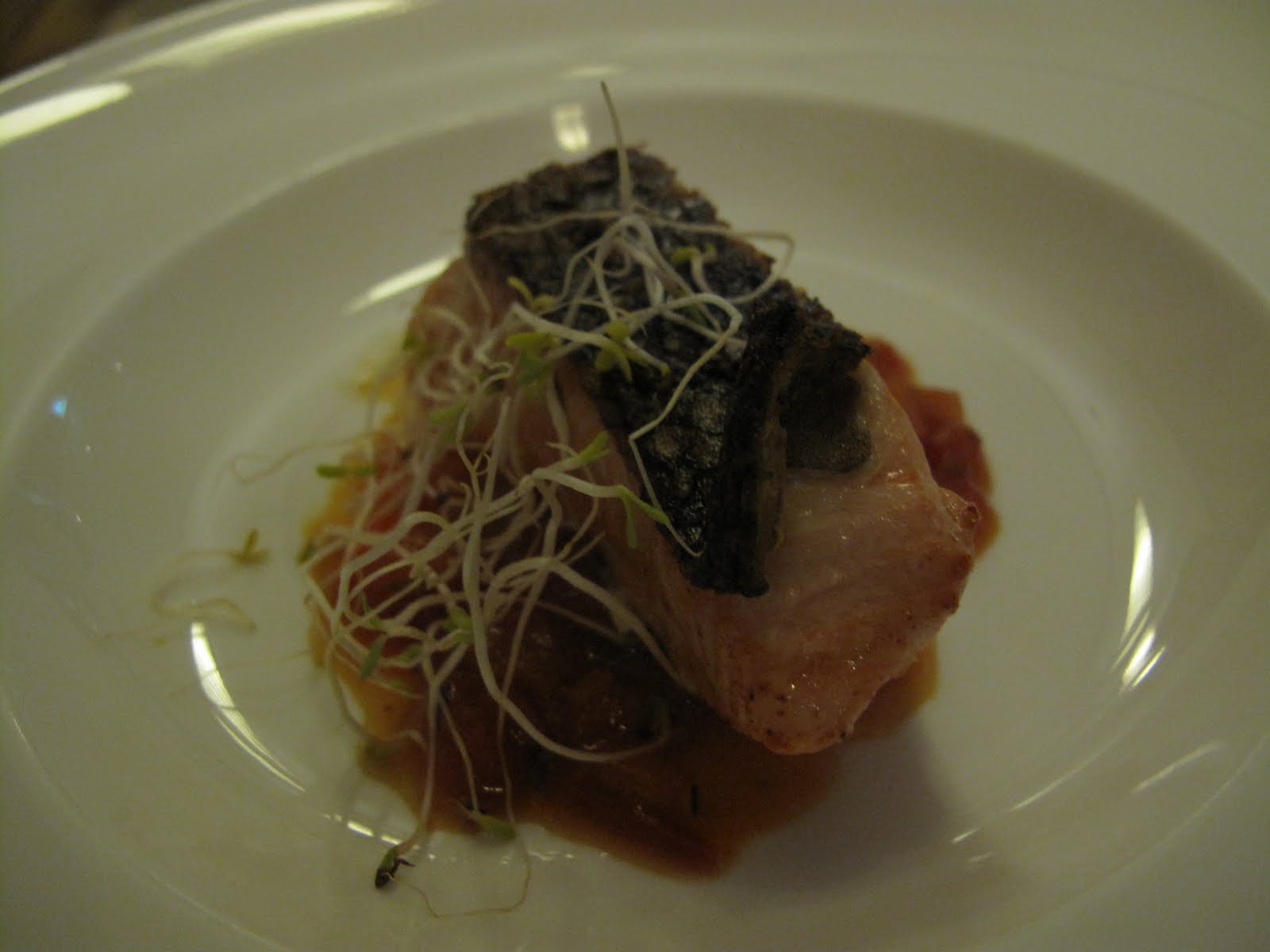
The warm appetiser is a baked salmon with tomato coulis, which is pretty failsafe: a dash of sour cream might have added a little colour and taste contrast.


I decided to have a different soup this time, and chose a the truffle-infused cep and morel mushroom soup ($9.50). This arrives with some ceps and morels in the bowl, and a thick mushroom soup is slowly poured over them. A good idea, and good presentation, but, as I have discovered through my own experiments at home, rehydrated cep and morels are not great ingredients to work with: dehydration tends to rob them of their precious aroma, while rehydration tends to cause them to emit grit and sand which, if care is not taken, can end up in whatever you are cooking. Sure enough, my mushroom soup, while more robust than some others I've tasted, lacked any olfactory hint that it contained ceps or morels, and at one point I bit down with a loud crunch on a sand crystal.


The executive menu offers you a choice of three main courses: a braised lamb shank infused with cep mushrooms and served with seasonal vegetables, a duo of poached threadfin and seared scallop with roasted baby carrots and ginger cream, and a grilled Australian sirloin with truffle red wine glaze on a bed of leek. You can't tell from the awful photo, but that's the grilled Australian sirloin.


I had, for my main course, the masala lamb rump on a bed of ratatouille with a lamb jus reduction ($30). I found this a little tough, actually, though I had no complaints where flavour was concerned.


What really surprised me, however, was the dessert that came with the executive menu. Yuck, I had thought, when I first read "yam gateaux and mango cream with peanut royaltine", imagining some gruesome, Westernised version of a yam dumpling or taro paste. Instead, an elegant pastry presented itself, with the yam made into a sort of mousse. Having tasted some, the taste of the yam was not at all intrusive, and was instead delicately sweet, and complemented by the mango cream and the richness of the crispy peanut butter base.

The Dunearn, tucked away in a quiet corner of the Bukit Timah campus, may not serve up perfection, but its earnestness is extremely endearing, as are its attractively priced set menus. A wide variety of dishes is on offer, virtually spoiling you for choice, and giving certain value for money. Please note, however, that the restaurant does not accept cash, so you have to pay by card (unless you're a member of the NUSS Graduate Club, in which case you can probably charge it to your account), and also has a dress code which frowns upon shorts and non-collared shirts.

The Dunearn
1F Cluny Road
Bukit Timah Guild House (NUSS Graduate Club)
Tel: +65 6586 3260
Website
Monday, March 15, 2010

Miscellaneous Food: Sugarpaste Flowers


While Colin has been off eating, I've been...making flowers. Literally. I've decided to take on a new class, a cake decorating class. This itself is not great news (well, it is, I'm doing it for myself, which is pretty cool) and I've found that I'm not too far behind the other students and that I can pretty well understand what is being taught (yay). My final project though, is a 2 tier cake, decorated with the sugarpaste flowers that we have learned over the last few weeks.

And you can help by voting on what you think would be the best idea. Of course, if I wanted to ace the class, I should make a heavily calico-ed flower cake like the one above, though fashioning, painting and then adhering millions of little flowers and leaves, doesn't really appeal to me. What does, is creating a cake that is accessible, that is vaguely representative of my style (though I would like to experiment a bit), yummy to eat and that shows off at least some of the realistic and fantasy flowers that we learned in class (I do have to pass, after all).

I'm not saying that I can actually do these designs I have in mind, especially since I haven't actually tried making anything but a buttercream layered cake (I confess I might buy a fondant one if it comes to that) and technically, the cake itself is not part of the final grade. But I can try. And I figure, I can use colour to my advantage. These pictures are meant to simulate elements of the design only.


The first idea that I had was a pale pink round cake with a very sharp edge. It would be flocked with a garland of petally flowers, these wold be a mixture of slightly old-fashioned, large wavy, frilled petalled flowers with pale yellow stamens in the middle, think freesias, gardenias, sweet peas. I've seen a version of this cake and what makes it beautiful is that the flowers are different but similar shade of pinks, rose-reds, lilac pinks. The whole cake is monochromatic. Sort of like a sophisticated Cath Kidston look. The cake layers can be chocolate, or lemon with raspberry flavoured pink buttercream.


The second idea is a round pale blue cake, with white pansies. These pansies have soft petals and frilly inside petals, with dramatic textured black centers. The cake could be a pale teal Tiffany blue or a sky baby blue. The cake could also be rimmed along the bottom (if light enough in blue) with a pleated tan leather ribbon. This cake is like a modern Martha Stewart look. The inside of the cake is a dark chocolate.


The third idea is a light tan coloured cake. This colour is probably best described as taupe, or mauve. The pansies are still white, feathery and with textured black centers. They are meant to pop on the cake. The cake lends itself well to swiss dot decorations in white, too. The cake is still modern, but now modernist, stylish but not sweet. If it is done in buttercream, the cream is flavoured with salted caramel and the cake layers inside are chocolate. The cake could be done in a round to look more traditional, or a square to look even more modern. These second and third ideas are a bit simpler in terms of "flower execution" because there is basically just one type of flower.


The fourth idea is fashioned after these parrot cakes. The cake is a tall square cube, frosted in a pale buttercream yellow lemon and topped with an explosion of red and yellow parrot tulips and sweet peas. The colours are bright and a little clashy, so it will probably wind up being challenging from a colour-control point of view. The cake underneath would be a lemon poppy seed, layered with lemon curd or raspberry puree.


The fifth cake is a pure bright-white cake. The flowers are slightly fantasy pansies, they have white petals but the insides frills are kelly green, with a textured white center. There aren't these flowers in real life but it's sort of an inside joke, like painting the inside of your white kitchen cabinets green. The challenge is definitely keeping it real-looking, with just that bit of shock effect, I guess that means the colour has to be just that right shade of green (ie. not too artificial). The cake is meant to look fresh and fun, it's meant to sit on top of a white and green checkered gingham. The cake could be dark chocolate on the inside but it could also be lemon poppy seed.

What do you think?


For those who have no idea what these flowers are, a sampling of the kind of stuff we made in the first class: