Sunday, July 15, 2012

Review: The Clan Restaurant


You may have noticed that it has been a very long time since I last posted on this blog, and I’m grateful that my sister has been updating in my absence. The reason for the radio silence is that I started a new job in February which has been keeping me extremely busy. These days, I’m lucky if I get to eat out once a week, so finding time to write reviews might be asking for too much.

Recently, though, my family celebrated some birthdays, and it fell to me to look for a suitable venue for dinner. I had originally intended to book Pollen, Jason Atherton’s newest restaurant at Gardens by the Bay, but surprisingly it was already fully booked for Wednesday when I called on Sunday. Given that it was a special occasion, I was reluctant to go for the run of the mill Italian or French, but at the same time I didn’t want to break the bank at Les Amis or Waku Ghin. Remarkably, though, it was not easy finding a pleasant, affordable modern European restaurant which would promise an enjoyable evening: we had not been impressed with 7Adam, Table66 was no longer open, and the menu at Private Affairs was rather too limited.


Eventually, however, I stumbled across the website of The Clan Restaurant, a restaurant so new that no “official” reviews could be found in the print media. All I had to go on were about five effusive Hungrygowhere.com reviews, and those are not always particularly reliable.

Still, I had high hopes when I called up to make the reservation, for Raymond and Chris, the two front of house I spoke to, radiated friendliness and accommodation down the phone line. “You would like to bring a birthday cake, sir? No problem at all, but just so you know, you might be too full for cake after our set dinner, which includes dessert!” “Party of six? I can give you your own private dining area in front of the kitchen, where you won’t be disturbed by any of the other diners”. This is the kind of personalised service our dining scene lacks, and it really set the scene for a lovely evening.


Located in the charming Bukit Pasoh district, just up the road from the Majestic and Absinthe, The Clan Restaurant is unmistakable, given the well-lit signage and the imposing black and white signboard of the Gan Clan Association, whose premises the restaurant occupies.

In person, Raymond and Chris turned out to be just as warm and helpful as they were over the phone. Special requests were taken care of without a second thought, recommendations were freely volunteered with candour, and when we expressed interest in one of the desserts, a complimentary helping was immediately served.

As it turns out, The Clan Restaurant is the successor to Dozo, and there is a fair amount of resemblance in the décor and the food. The focus on set menus, for instance, stands out instantly (although a la carte menus are also available on request). At $42 and $68 for a 5-course lunch and a 6-course dinner respectively, The Clan Restaurant offers excellent value for money.


Dinner began with a refreshing green apple palate-cleanser shooter, which was kept lightly aerated by being churned in a machine that looked like it used to dispense 7-Eleven slurpees. Cold, sweet and zesty, this was an excellent start to the meal.


The appetiser is the only part of the menu that is not open to choice. Instead, everyone gets a trio of salmon mousse (served in a miniature ice cream cone), pan-seared scallop with truffled asparagus and foie gras terrine with cranberry sauce. A sort of surf 'n' turf, I suppose. While the foie gras and salmon mousse were extremely competently prepared, the real standout was the scallop, which was beautifully seared, very well paired with the asparagus and topped with a heady truffle foam.
 
Given that there were so many of us, we could easily order almost every cold starter off the menu and sample the restaurant's offerings at our leisure.


My beef carpaccio with truffle mustard tossed mesclun salad in truffle teriyaki and horseradish sauce came highly recommended, and it was not difficult to taste why. The carpaccio slices were well-marbled, and the salad was both eye-catching and a great complement to the raw beef. I would have preferred a lighter hand with the teriyaki sauce, however, as I felt that its cloying sweetness overpowered the taste of the beef and the zing of the horseradish.


The Alaskan king crab with homemade karashi dressing was another favourite, and here, bereft of any artificial enhancements, the natural sweetness of the crabmeat really stood out.


I am not a fan of oysters, and so a cold starter of oysters done in three ways didn't really appeal to me, but my mother, who had the dish, certainly had no complaints. 

Warm appetisers followed, with a number of options to choose from.


The tempura espuma soft shell crab with homemade sauce boasted an amazingly light yet crispy batter, doing justice to the kitchen's Japanese training.


Escargot is not the most common of appetisers, and The Clan's herb crusted mushroom escargot was perhaps a little on the dry side.  


The kurobuta pork belly confit with pork cracker and passionfruit sauce seemed a little haphazrdly put together, and I was expecting the rind to have been roasted to crackling instead of being a soft, slightly disembodied piece meat. I suppose, however, that that was what the pork cracker was there to make up for, and at all events the sweet and tangy passionfruit sauce stood in for a more traditional applesauce.


The soup course was up next, and mushroom soups often tend to be a little bit underwhelming. The Clan's offering of ceps mushroom soup with truffle paste, however, was simply bursting with flavour. Thick, luscious, heady and intense, this was one of the tastiest mushroom soups I'd had in some time.


The double-boiled beef consomme, perhaps because of the addition of shallots/spring onions, had a slightly Oriental perspective, entirely in keeping with The Clan's Asian roots.
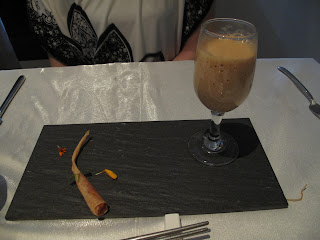

What is particularly intriguing about The Clan's approach towards its cuisine, however, is its willingness to take risks. The crab bisque cappucino, for instance, was pumped out of a siphon in order to create a superb, foamy head floating atop the bisque (and, perhaps, to justify not having to serve a large portion), but as a result the soup had to be served at room temperature rather than piping hot. That I think weakened the dish, notwithstanding that the flavours imbued in the bisque were spot on.


I remember when the restaurant industry was caught up in the craze that was "fusion cuisine", and I remember disliking the pretentiousness of it in the hands of chefs who were recklessly throwing ingredients on a plate. Happily, The Clan uses Eastern and Western ingredients with equal facility, and thought clearly goes into what goes into each dish. The crispy barramundi with herb salsa, squid ink garlic salsa and crustacean oil pasta was a great combination of fresh barramundi, toothsome shrimp pasta and briny squid ink sauce.


The Clan's signature main course probably has to be its 48 hour short ribs with madeira sauce, an elaborate dish of slow-cooked beef and Japanese mushrooms atop a superheated stone, with only a hoba (Japanese magnolia) leaf for insulation. That allows the diner to cook the beef to his or her preferred doneness, although there is a slight problem in the execution of this idea: the meat is actually quite tepid when first placed on the hot stone, with the result that, if you prefer your beef pink it will be slightly cold, whereas if you want your beef warm it will be somewhat overcooked. Drizzled over with madeira sauce, and infused with the smokiness of the hoba leaf, the beef was succulent and very tasty.


An enormous spiced braised lamb shank with potato panko and extra virgin olive powder will ensure that, if you weren't already feeling full by this course, you'll be absolutely stuffed by the time you're through with it. 


I believe my sister was not that enamoured of the green tea tiramisu, which is in any case a dessert I am always slightly suspicious of.

I am clearly out of practice, because I forgot to take a photo of my signature chocolate fudge, which was excellent. Less like a fudge and more like a dense mousse, it was sinfully rich and will definitely be a treat for all chocolate lovers.


As a result, the chocolate lava cake probably paled slightly in comparison, but nonetheless, The Clan's version of this stalwart is a credible one.


Clearly pandering to local tastes, however, are the profiteroles, as the choux pastry buns are filled not with chantilly, but with durian cream. Unsurprisingly, this is apparently a real crowd favourite.

With lots of new restaurants opening this year (I have Pollen in my sights), I was really pleasantly surprised by The Clan. Lovely food and exceptional service at unbeatable prices in a restaurant that is open for lunch and dinner every day is a truly winning combination. 

The Clan
18/20 Bukit Pasoh Road
Singapore 089832
Tel: +65 6222 2084


Thursday, May 17, 2012

Miscellaneous: Pierre Herme's Jasmine, Mosiac and Paris Match macarons

I always find baking with the Mad Baker (she runs her fantastic blog here) an educational experience (and for her, I suspect a somewhat frustrating experience). This weekend was no exception. We had fixed to do several flavours of PH macarons, except that I kept changing my mind, getting tempted by this macaron and then that.

Finally, we came to a compromise. We would do over one flavour that we had tried before, the Jasmine flavour. We had tried this before, using PH's method of steeping jasmine tea in cream and white chocolate and it had, flavour-wise, been a fairly dismal flavour, as the scant aroma of tea dissapated within a few hours. Upon reading the recipe carefully, I discovered a footnote (this is why I think the book is more than a little shoddy) that said, "I use Sambac jasmine essence". Well! Shouldn't that be the first thing and not the last thing that you mention?

Since I had procured a bottle of said essence, I was keen to give it a go. The second flavour, which MB was more keen on, was the Mosiac macaron, which featured a pistachio and cinnamon ganache stuffed with a Griottine cherry, which is a cherry soaked in Kirschwasser (or Kirsch water). It sounded kind of Teutonic, to be honest but an intriguing contrast.

The last flavour was a chilli-ed chocolate, which we were both a little dubious about. "Chilli chocolates are totally overhyped" MB said. Reading the recipe carefully, I discovered that the kind of chilli was actually more like a bell pepper powder. I clearly didn't read the recipe carefully enough, as I missed out that you needed an actual bell pepper for the ganache (we compensated by using more bell pepper powder). The ganache also contained raspberry (it was alternately translated as strawberry and raspberry in different parts of the same recipe, which just confirms my point about shamefully shoddy editing) so I felt that it might give a good contrast between sweet and spicy tastes. I didn't expect them all to be equal winners but the fun thing about trying out these recipes is that you are always educated about new flavours, tastes and possibilities.

The baking itself was fairly uneventful, except that our meringue seemed a little stickier than usual (and indeed the shells were slightly more dense than my last couple of batches). I suspect this is because I was in charge of beating the meringue this time, while I usually leave the egg whites to MB and perhaps also because of the large batch that we were attempting. She was nice enough to let us mess around with the ganache and piping of meringue, while she soldiered on with the baking, matching and piping the fillings.

We literally had piles and piles of little macaron shells and we split the loot over dinner and the next day. Our audience ranged from being huge fans of the Paris Match, to ambivalent on the Mosiac and "it tastes medicinal" on the Jasmine. My own assessment was that after my enthusiastic dousing of the ganache with Sambac essence, the Jasmine smell and taste was somewhat overpowering and shall we say, ethnic. The Mosiac was an interesting combination but the Griottine cherry was a smooth and rummy, rather than a sharp finish- I preferred the pistachio with the raspberry gelee in PH's Macaron Montebello fetish creation. The Paris Match was unexpectedly my favourite amongst the three and the only one that I would probably make again. The raspberry brought out the tannic taste of the dark chocolate perfectly and the bell pepper chilli left a broad, savoury and spicy finish to the sweetness. It was absolute perfection and a genius in taste-making.

While storing the macarons, I had a good idea to leave the Jasmine macarons in the same box as the others, in the hope that the flavour (for jasmine is a weak scent) would disappate overnight. I was somewhat mollified when my colleagues told me the Jasmine was awesome the next day and then after the unexpected heat of the Paris Match, the Jasmine left a beautiful fragrance all the way down the throat.

Sunday, April 29, 2012

Miscellaneous: Pierre Herme's Frivolite Macaron

I'm not quite sure why I leapt into making PH's Frivolite macaron, which featured salted caramel and dried green apples. I already had so many things to do today! The lesson clearly, is that you must not delve into PH's delicious book unless you want to while away an afternoon!
I think part of the reason is that I'm making three new PH flavours with MB on Labour Day and this was part of my plan to get excited! The other reason is I'm a new aunt (well, aunt-once-removed, since it's my cousin's new baby) and I thought I would make a classic but pretty flavour to welcome little baby girl J into the world.
This recipe is a fairly simple one, without any staining of the shells. The first step was to cube a green apple, he calls for 8mm cubes, sprinkled with lemon and granulated sugar, then dried in a 90C oven for 1 hour.
This is really simple to do and the results are interesting. The cubes of apple shrink in and become chewy, almost like a soft, fiberous pillow. One thing about these small pieces is that they often get lost in the salted caramel, if I were to make it again, I would slice small coin-shaped rounds of apple and dry those to make for more bite in the macaron filling.
Of course, I was also tempted by other colours and patterns of shells, in particular his Chilli Chocolate macaron named "Hope", which featured red and white shells, each dripped with the alternate colour. The lesson here is to drip the alternately coloured batter while the shells are still wet and before they form a shell, then, like the green shells, the pattern will be part of, rather than built onto the surface (as in the white shells).
To my surprise, the shells came out roughly the same size. This is probably because the green shells were piped slightly smaller. This batch of macarons were also much fluffier than the last few, I've realized that if I whip the meringue at a faster speed but for a shorter period of time, the meringue volume is larger and the shells will get some air bubbles, but the texture is much lighter and aerated.
I also brought the baking time down by a minute, which produced a just-right texture. This was evident from the macaron height and the crisp yet delicately fragile feel of the underside of the shells. I knew they were good since my picky father praised both the look and taste of the macaron as "I must say, these are very good".
I matched up the green to the white shells and piped in the salted caramel buttercream filling. If you follow PH's salted caramel recipe, you will get a more caramel heavy filling, as he beats in butter, rather than butter meringue. His filling will be stronger, sweeter and denser, but probably more liquid, so the macarons will definitely be flatter but the apple pieces might be easier to discern.
I think they look really pretty in the mixed colours, don't you? I looked up the Frivolite recipe online and found the recipe easily available but most of the pictures of the macarons on blogs, to my mind, don't pass as macarons- either the filling is melted, the shells have no height or the bakers have taken real liberties with the colouring.

Monday, April 23, 2012

Miscellaneous: Attending the Savour fair in Singapore


I attended the Savour fair this past weekend in Singapore, which was held at the F1 pit building. Tickets were $42 each with $21 of those dollars redeemable in Savour dollars.

The ground level of the carpark had been covered in white marquees, with the more atas (high-end) restaurants and brands setting up stalls. There were local names like Gunthers and but also foreign names like L'Apage and Pujol and each restaurant was housed in a marquee and fronted by low table counters where staff hawked a trio of dishes. There were also booths manned by food-related brands like San Pelligrino and Acqua Panna.

All the restaurants were offering tastes of their 'specialties', like L'Apage, where we purchase their cold egg and tomato
What I found disturbing was, these places were charging obscene prices for a tiny smear of food- this thin slice of pork belly for example, cost $21 dollars! And so it went, each stall was $14 for a bit of this and $19 for a piece of that, all served in disposal little cups and bowls with plastic utensils.

I know that the idea was to introduce these signature dishes and foods to people who might not have the opportunity to travel to eat at these well-known restaurants. But I would have thought that even the chefs would have found it insurmountable to charge those kind of prices for the product. The portions were far less than what you would have experienced at the restaurant itself- for example, Gunther was offering, literally, a mouthful of their cold angel hair ostrecia caviar pasta for $19 but at the resturant, a full and far heartier dish of the same doesn't cost much more.

Some of the items were so small, it was laughable, for example, people were carrying expensive sushi maki or molecular xiao long bao around in miniscule cupcake wrappers. In the end, we had to wander over to the Chinese restaurants, like Hua Ting, that were offering more substantial plates of XO carrot cake and noodles.

You also blew through the Savour dollars at a slightly ridiculous rate, the books of tickets came in $3 denominations but the lowest price of any dish or even a glass of cider cost $9 and most of the food on the ground level cost $21 so you would use up an entire book of tickets on a thin slice of pork belly or thimble of cerviche. Thankfully the rain came pelting down and we had to migrate to the grandstand area where the exhibitions and classes were being held.

These areas were lots of fun to explore. Each floor had three exhibition areas and each would hold up to 20 stalls, selling everything from organic vegetables (Zhen Xin) to soy products, cupcakes, to macarons, to bread and meats. This is where, we discovered, we should have come for lunch. Food here was much more reasonably priced, $9 for a set of sausages from The Greengrocer or a toasted panini, to $6 for a slice of Windmill Pie and $6 for a coffee from Oriole. Even then, it was somewhat artificially priced in denominations of $3 and made items more expensive than they would have been in-store. I was happy to pay the premium to be able to sample different food businesses, many of whom operate from a home kitchen or suburban location, which I would otherwise not get around to ordering from and collecting.

There were two exhibition areas devoted entirely to wine and the import of various liquors and oils. Half of a floor was also taken up by 360 Foods, which had set up a make shift supermarket area, showcasing their fresh meats, hams, cheeses, oils and sauces. The clientele was primarily well-heeled, with many groups of young, PR-looking girlies and there was even a non-alcoholic and children's play with food area set up.

In the classes, the group was slightly more professional and with a culinary background (for example, several popular classes were oversubscribed and everyone in the 40 strong crowd owned a Kitchenaid). I saw several culinary entreprenuers and many bakers that I've met over the years. We attended two classes, a bread making class and a food styling class. Both classes (since they were free, I wasn't that judgemental) were very interactive and fun to attend. The bread class provided us with samples of flour, yeast and a generously-sized ball of dough each, to roll out and knead.

One thing that I felt could be improved was probably the logistics of the fair, particularly at the classes. While there were ample service people around, they were aimlessly directing traffic and didn't seem to have much control over the situation, the rooms nor the attendees. Also, the facilities were clearly lacking; for example, during the bread class, we didn't have the opportunity to make bread from scratch, nor to, at the end, make any bread product at all. Even with the instructor's lovingly prepared dough, we were not able to roll it evenly on the filmsy plastic white tables, nor did we get a really good scientific explanation to bread making, as was done in the bread and cheese classes I attended in New York.

In the food styling class, it was a struggle to get the session going and this was not for want of effort or preparation on the part of the teachers. There was one chef and one photographer, the chef was struggling to chop vegetables on a small plastic cutting board and cook inside an enclosed, indoor space, on a thin small pan, perched on an Iwatami stove, on a white plastic table. The space was limited and the smoke from the cooking had nowhere to exhaust, forcing the cook into a harrid agitation and a slap-dash feel to the recipe. The oil splattered across the tables and the condensation from the pan, because of the tight space, wafted up onto the TV screen where the photographs were being flashed- I don't think the set up really did the classes any justice and for such a large event, the staging seemed inadequate and ill-conceived, even though the talent and substance was good.

Although I enjoyed myself and found it a good use of the $21 entrance fee, I felt that the tone of the fair was extremely commercial and there were many aspects (the steep food pricing, the food proportion from the celebrity chefs, the staging of classes and the interaction of the stalls) that could have and hopefully, will be, tremendously improved.

Tuesday, April 03, 2012

Recipe: Chocolate Babka


I don't really remember how the obsession with Dean and Deluca's Chocolate Babka grew. I don't even remember who it was who first introduced me to the slab of light but chewy chocolate bread, or who made me take my first bite; I only have a hazy memory of carrying a thin plastic bag around New York and slowly but surely infecting each one of my university mates with an odd love for this loaf. In our household, we even came up with a formula for how much to dampen it and how long to nuke it in the microwave for, to achieve maximum softness and chocolate richness. I once had a friend from Cornell mail me loaves of babka bread. Always chocolate, never cinammon.


Now I can finally recreate the taste sensation, with an even better version, I think, then Dean and Deluca's. Babka is a cross between challah and pain au chocolat, a Jewish holiday bread made luscious with butter and chocolate. Although the recipe takes a while to complete, the risen airy lightness of the crust and the sweet, slightly alcoholic crumb of the bread, is entirely worth it . I was taught this recipe in a New York winter by my dear friend M, who shares the most soulful food, reviews and photography at her site, melissamansur.com here.


Be aware that you need time to execute this recipe. You have to rest the dough for two hours between making and rolling it into the babka. You then need another two hours let the bread proof within the baking tins. So the earliest you can eat babka from the time you start is at least four and a half, more like five and a half hours.

M. traditionally uses 60% Schaffen-Berger chocolate in this recipe so I have stuck to that, but I have also used 70% Arugani Valronha chocolate. I've got the best results from chopping the chocolate very fine (you otherwise get lumps of unmelted chocolate) and sprinkling a little sugar onto the chocolate, as the recipe calls for. I use a egg yolk and whipping cream wash for the surface of the bread as I find milk too liquid, it leave a dark stain rather than a glossy shine. In Singapore, there are two kinds of dry yeast that are easily available in stores, the first is Fleichmann's Dry Active Yeast (in yellow packagin) and the other is a European bread yeast. I use the former as I find the latter gives a very strong, sour yeast flavour. The recipe leaves you with excess egg whites, so use them for macarons or to make a frittata afterward!


Chocolate Babka (Source: Gourmet | December 2006)

For dough:
3/4 cup warm milk (105–115°F)
1/2 cup plus 2 teaspoons sugar
3 teaspoons active dry yeast (from two 1/4-oz packages)
3 1/4 cups all-purpose flour plus additional for dusting
2 whole large eggs
1 large egg yolk
1 teaspoon pure vanilla extract
3/4 teaspoon salt
1 1/4 sticks (10 tablespoons) unsalted butter, cut into pieces and softened

For egg wash:
1 large egg yolk
1 tablespoon heavy cream or whole milk

For chocolate filling
5 tablespoons unsalted butter, well softened
8 oz fine-quality bittersweet chocolate (no more than 60% cacao if marked), finely chopped
1/4 cup sugar


Make dough:

1) Stir together warm milk and 2 teaspoons sugar in bowl of mixer. Sprinkle yeast over mixture and let stand until foamy, about 5 minutes. (If yeast doesn’t foam, discard and start over with new yeast.)
2) Add 1/2 cup flour to yeast mixture and beat at medium speed until combined. Add whole eggs, yolk, vanilla, salt, and remaining 1/2 cup sugar and beat until combined. Reduce speed to low, then mix in remaining 2 3/4 cups flour, about 1/2 cup at a time. Increase speed to medium, then beat in butter, a few pieces at a time, and continue to beat until dough is shiny and forms strands from paddle to bowl, about 4 minutes. (Dough will be very soft and sticky.)
3) Scrape dough into a lightly oiled bowl and cover bowl with plastic wrap. Let dough rise in a draft-free place at warm room temperature until doubled in bulk, 1 1/2 to 2 hours.


Assemble babkas with filling:

4) Line two 8inch x 2.5 inch loaf pans with 2 pieces of parchment paper each (1 lengthwise and 1 crosswise).
5) Punch down dough with a lightly oiled rubber spatula, then halve dough. Roll out 1 piece of dough on a well-floured surface with a lightly floured rolling pin into an 18- by 10-inch rectangle and arrange with a long side nearest you.
6) Beat together yolk and cream. Spread 2 1/2 tablespoons softened butter on dough, leaving a 1/2-inch border all around. Brush some of egg wash on long border nearest you.
7) Sprinkle half of chocolate evenly over buttered dough, then sprinkle with half of sugar (2 tablespoons). Starting with long side farthest from you, roll dough into a snug log, pinching firmly along egg-washed seam to seal. Bring ends of log together to form a ring, pinching to seal. Twist entire ring twice to form a double figure 8 and fit into one of lined loaf pans.
8) Make another babka with remaining dough, some of egg wash, and remaining butter and chocolate in same manner. Chill remaining egg wash, covered, to use later. Loosely cover pans with buttered plastic wrap (buttered side down) and let babkas rise in a draft-free place at warm room temperature until dough reaches top of pans, 1 to 2 hours. (Alternatively, let dough rise in pans in refrigerator 8 to 12 hours; bring to room temperature, 3 to 4 hours, before baking.)
9) Put oven rack in middle position and preheat oven to 350°F.
10) Brush tops of dough with remaining egg wash. Bake until tops are deep golden brown and bottoms sound hollow when tapped (when loaves are removed from pans), about 40 minutes. Transfer loaves to a rack and cool to room temperature.


Cooks’ note:
Babkas keep, wrapped in plastic wrap and then foil, frozen 3 weeks.
Yield: Makes 2 loaves
Active Time: 1 hr
Total Time: 6 1/2 hr