Monday, March 07, 2011

Recipe: Yuzu Tarts


I Was intending to rest this weekend, having travelled in spats for most of the month but Colin easily convinced us that a trip to TOTT was long overdue. The place is a wonderland of kitchen appliances, steamers, knives, pots and all manner of culinary goodness, including some gourmet ingredients for tarts and savouries. I was immediately reminded of the Japanese yuzus that I had from a recent trip, still sitting in my fridge. Between yuzu tarts and taking a break, what's a girl to do?


I filled half of the sweet tart dough with chocolate ganache and then the other half with yuzu cream, made from the Pierre Herme lemon cream recipe, also found here on this blog. In place of lemon juice and rind, I used yuzu rind and juice and topped up with a bit of orange juice.


Ingredients:
1/2 cup sugar
Finely grated zest of 2 yuzus
2 large eggs
1/4 cup fresh yuzu juice, topped up with orange juice
180 grams unsalted butter, cut into small pieces

Put the sugar and zest in a metal bowl set over the pan of simmering water. Rub the sugar and zest together until the sugar is moist, grainy and very aromatic. Whisk in the eggs, followed by the yuzu juice. Keep whisking to stop the eggs from scrambling. The bubbles will get bigger, and then, as it gets closer to 180 degrees F, it will start to thicken and the whisk will leave tracks. As soon as it reaches 180 degrees F, remove the cream from the heat and let it cool. Strain it into the container of the blender and discard the zest.

Turn the blender to high (or turn on the processor) and, with the machine going, add the butter about 5 pieces at a time. Scrape down the sides of the container as needed as you incorporate the butter. Once the butter is in, keep the machine going—to get the perfect dreamy, airy texture, you must continue to blend the cream for another 3 minutes. I kept the machine going till the cream thickened up into a spreadable consistency but you can also leave it to harden in the fridge.


Later, when they had set, I topped each yuzu tart with a raspberry and the chocolate tarts with melted, smooth ganache and then flecks of goldleaf. There's something about tarts that makes me so happy on a sunny Saturday! These little cases are a real treat too, I'm thinking of filling them with darjeeling cream (like mini darjeeling tea tarts) for future tea parties.

Recipe: Pecan Butter Cookies


If you are looking for an easy-peasy snack, this is one of those brilliant cookie dough recipes that you can make ahead of time (like Dorie Greenspan's World Peace Cookies) and freeze for later use. The dough is rolled into spherical logs and then cut into rounds for baking.

This quintessential "Cookies with Milk" recipe is great to use with children who like to help with baking and really helps when you need some quick kid dessert in a pinch or for bringing to school or birthday parties. You can also add some chocolate chunks as a treat or to replace part of the sugar; I've adapted the recipe from the Williams-Sonoma cookbook and have already cut the proportion of sugar in half as I find American cookie recipes in particular a little too sweet.


Ingredients:
200 grams unsalted butter at room temperature
1/2 cup sugar
A pinch of salt
1 teaspoon vanilla extract
2 cups all-purpose flour
2/3 cup pecans, chopped

Method:
1. Cream the butter, sugar, salt and vanilla with an electric mixer until smooth and creamy.
2. Add the flour and pecans and continue mixing.
3. Roll the dough into 2 cylindrical logs and wrap in cling wrap. Refrigerate until firm, at least four hours.
4. Pre-heat the oven to 175 degrees Celsius.
5. Cut the log into slices of about ¼-inch thick and place on baking trays lined with parchment paper.
6. Bake for 14-16 minutes until edges are golden brown.
7. Cool completely on wire racks.

Tuesday, January 18, 2011

Recipe: Roast Beef


What do you see when you look at this photo? I don't know about you, but I see beauty. Beauty in the freshness and redness. Beauty in the rich seams of fat running through the meat, like so much geological strata. Beauty in the arch of the rib bone. It's sad, when you think about it, that fresh, respectable produce should be considered the province of the well-heeled, and yet we think nothing of children sporting iPhones, or young professionals aiming to buy flashy cars with their first years' paychecks.

Which is why I think Hugh Fearnley-Whittingstall's The River Cottage Meat Book is one of the best food books I've read. Not only is it an excellent cookbook, it's also an apologia - an intellectual and philosophical defence, and advocacy, of the love of meat. More importantly, however, Fearnley-Whittingstall preaches respect: it's fine and dandy to love eating meat, but do you really respect the animal that gave up its life for your steak? Do you understand how meat should be reared, fed, husbanded, slaughtered, aged, carved, cooked and served? Would you bat an eyelid if you learned that the lamb in your stew had been boiled rather than simmered?

I often reread parts of Fearnley-Whittingstall's work, and I am constantly rewarded with new insights, and forced to re-examine many of my own views and beliefs. It's true, of course, that one needs to either have a lot of time or money (preferably both) to live religiously by the author's example (he rears his own cows and makes his own sauces), but that doesn't mean one can't try.

With that in mind, I decided to cook a roast rib of beef for New Year. I've always found the thought of cooking an entire forerib fairly intimidating - something which was not helped by my mother's gloomy prognostications of undercooked beef and oven racks being unable to support the weight of massive pieces of meat. Having read and re-read the recipe provided by Fearnley-Whittingstall, however, I was convinced by the simplicity of his prescribed method, which is as follows:


1) Depending on how many people you plan to feed (1 rib will feed about 2 to 4 people, depending on whether you have any side dishes), buy a roast of between 2 to 6 ribs ($56 per kg at Huber's Butchery). Most home ovens will not be large enough to accommodate a full 6-rib roast, so ask your butcher to cut the rib into half.


2) Preheat your oven to 220C. Trim off as much excess fat from the rib as you like, leaving as much as you feel comfortable with (some fat is necessary to lubricate the meat and keep it moist). Season with salt and pepper, and then place the rib in the oven to sizzle for 30 minutes. It is important to notice that this "half hour sizzle", as Fearnley-Whittingstall terms it, is a pretty reliable guideline: almost all meats of any size can be seared in the oven at 220C for 30 minutes without drying out, save for very small (less than 1kg) joints of meat or game birds (e.g. pigeons or small chickens), which therefore require a shorter sizzle. Conversely, large roasts may benefit from a slightly longer sizzle (e.g. 45 minutes).

Those who are familiar with cooking meat will recognise this as essentially a browning process, and the advantage of doing it in the oven, rather than on the stove, is that there's no need to keep turning the heavy piece of meat to ensure an even sear, and you'll only need to clean the inside of your oven, rather than all over your stove top (albeit your oven will get rather oily as the oil spatters).


3) After 30 minutes, your meat will have developed a nice, brown crust, like the one you see in the picture above. Turn the oven down to 160C (you can leave the oven door ajar for a minute or two to help it cool down more quickly), and then continue to roast your beef, using the following timelines as a guide: 9-10 minutes per 500g for rare, 12-15 minutes per 500g for medium, and 18-20 minutes per 500g for well done. The shorter cooking times are for joints of 5kg and above. Having used these guidelines myself, I must say they are uncannily accurate, although for best results I would of course recommend a meat thermometer (the temperature at the thickest part of the joint should read: 50C for rare, 60C for medium and 70C for well done).


4) Take the beef out of the oven, and let it rest, lightly covered with some tin foil to keep it warm, for half an hour. It it exceedingly important that the meat is left to rest, as this gives the meat's juices a chance to settle down and redistribute back into the meat, ensuring that the meat will be moist, rather than dry, when it is served. While the meat is resting, you can use the time productively to prepare a quick sauce, or check on whatever side dishes you've decided should accompany the beef.


5) Carve the meat on a large cutting board, preferably one with an indented rim to catch the juices that are bound to be released. As you can see, although the photograph is a little dim, Fearnley-Whittingstall's timelines really do work, to produce, in my case, an amazing medium-rare prime rib roast, which I served with simple mashed potatoes.

It should be apparent by this point that a beef rib roast need not be a daunting affair at all, and in fact it is one of the most simple dishes I've cooked. For something so uninvolved, however, the results are invariably stunning, and no one can resist a roast rib, so you be sure that the roast will be demolished in no time.

If I haven't convinced you by now, The River Cottage Meat Book really is a worthwhile read, and I strongly recommend it to anyone who cares about, or would like to know more about, their meat.

Monday, January 17, 2011

Miscellaneous Food: New Zealand Part 3

I apologise for the long wait in between posts - it's been one of those weeks, or months, rather, at work. Thankfully, there'll be a bit of a breather before the next onslaught, and hopefully I can catch up on a few more posts.

Day 5: Napier

Lunch

Before we knew it, it was Day 5, and we were in Hawke's Bay - arguably New Zealand's wine capital. I had originally planned for us to arrive in Napier just in time for lunch at Fox on the Quay, a restaurant by the bay that promised "fine food, casual dining". Unfortunately, I had forgotten that it was a Monday, and, as a result, the restaurant was closed. While we did manage to lunch somewhere else nearby, the food was pretty mediocre, and quite a disappointment after we had been looking forward to a good meal.

Nonetheless, that was quickly forgotten after an entire day of wine-tasting at two artisanal wineries, as well as at Napier's flagship winery and vineyard, Mission Estate, which rounded off with a lovely tea spread of crackers, pate, cheese, and chutneys.

Fox on the Quay
14 West Quay
Ahuriri, Napier
Hawke's Bay


Dinner

I'd researched where to go for dinner when in the Napier area, and one recommendation which came up a few times was Terroir, the restaurant of the Craggy Range winery in Havelock, about 30 minutes' drive out of Napier.


It's easy to see how the Craggy Range winery acquired its name: it's nestled up against the most gorgeous mountain range which, in addition to being picturesque, must also do wonders for the micro-climate, and probably explains why Craggy Range consistently produces top-quality wines.


The winery itself is also beautiful, housed in muted, earthen colours of tan and sandstone. Partly because it was dinner time, and partly because of the location, there was a great sense of serenity, sobriety even, as if this were the altar upon which prayers to Dinoysius were answered, as opposed to the location of Bacchanalian delights.


Terroir, the restaurant, is no less visually impressive, with a magnificent fireplace in the centre of the dining room, the chimney of which also serves as the central pillar holding up the vault of the ceiling. The wooden rafters and beams give the appearance of a huge oak tree spreading its branches, in keeping with the restaurant and winery's terrestrial, natural feel.


Unfortunately, the food did not live up to its surroundings, with the meal beginning with S's starter of mille feuille of marinated oyster mushrooms and caramelised garlic vinaigrette. Although the puff pastry was delightfully light, the oyster mushrooms had been marinated in white wine or verjus, leaving them sour and unnatural. For $21.50, this left a rather unpleasant taste in the mouth, both literally and figuratively.


My Provencal fish soup, coloured with saffron, flavoured with Pernod and served with rouille, croutons and Gruyere cheese, was better, and certainly came in a generous tureen, but I thought it could have been richer and headier; though I suppose I was asking for it, ordering a fish soup in a restaurant called "Terroir".


The woodfired fish of the day was a sole, served with fried potatoes, aioli and a preserved lemon. By this time night was beginning to fall in earnest, hence the poor quality of the remaining photos. The portion was far too large for S to finish, though she did like the potatoes.


My seared lamb loin, served with a cauliflower puree and a red pepper, olive and caper salad, was enjoyable, which was unsurprising, considering how good New Zealand lamb is. However, in contrast to the size of the fish, I thought they could have served a larger portion of lamb, even allowing for the fact that loin cuts are generally the pricier parts of the animal.

We were very full and very tired from the wine-tasting, so we decided to forgo dessert, but I was more than slightly disappointed by what Terroir had to offer. While the food wasn't bad (perhaps with the exception of the mushroom millefeuille), I suppose I had expected rather more as a result of the ambience and reputation. Perhaps, when it comes to food and beverage in Napier, I might just stick to wine.

Terroir
Craggy Range Winery
253 Waimarama Road
Havelock North
Tel: +64 06 873 0143


Day 6: Taupo

Lunch

After Napier, it was time to head back North towards Auckland, and the end of our journey. All good things come to an end, but that was no reason not to get a few good meals out of Taupo, which was our next stop.

Like the city of Rotorua nearby, Taupo is dominated by a massive freshwater lake that is larger than all of Singapore, and that was sufficient excuse for me to make a reservation at the Waterside Restaurant, a pub facing the lake and its boardwalk, where we could put up our legs and enjoy watching people go by.


Since we were having a fairly late lunch, I didn't want to ruin my appetite for dinner, and so I had a tiger prawn and calamari salad, with a coriander, chilli and citrus dressing. Again, a surprisingly Asian-influenced dish, but the prawns were nicely pan-fried, and the squid was fresh and tender. I didn't quite enjoy the crispy "nest" that sat atop my salad, but apart from that, it was a nice change of pace from all the meat I'd been having.


S's fresh pasta was infused with fresh basil oil and tossed with warm bacon, baby spinach, sun dried tomatoes and feta cheese, which all added up to quite a substantial meal, but it was refreshing nonetheless.

Waterside Restaurant
3 Tongariro Street
Taupo 1128
Tel: +64 07 378 6894
Website


Dinner

Fishing is a fairly heavily-regulated activity in New Zealand, which was somewhat surprising, as I didn't think over-fishing would be much of a problem given the ratio of people to landmass.


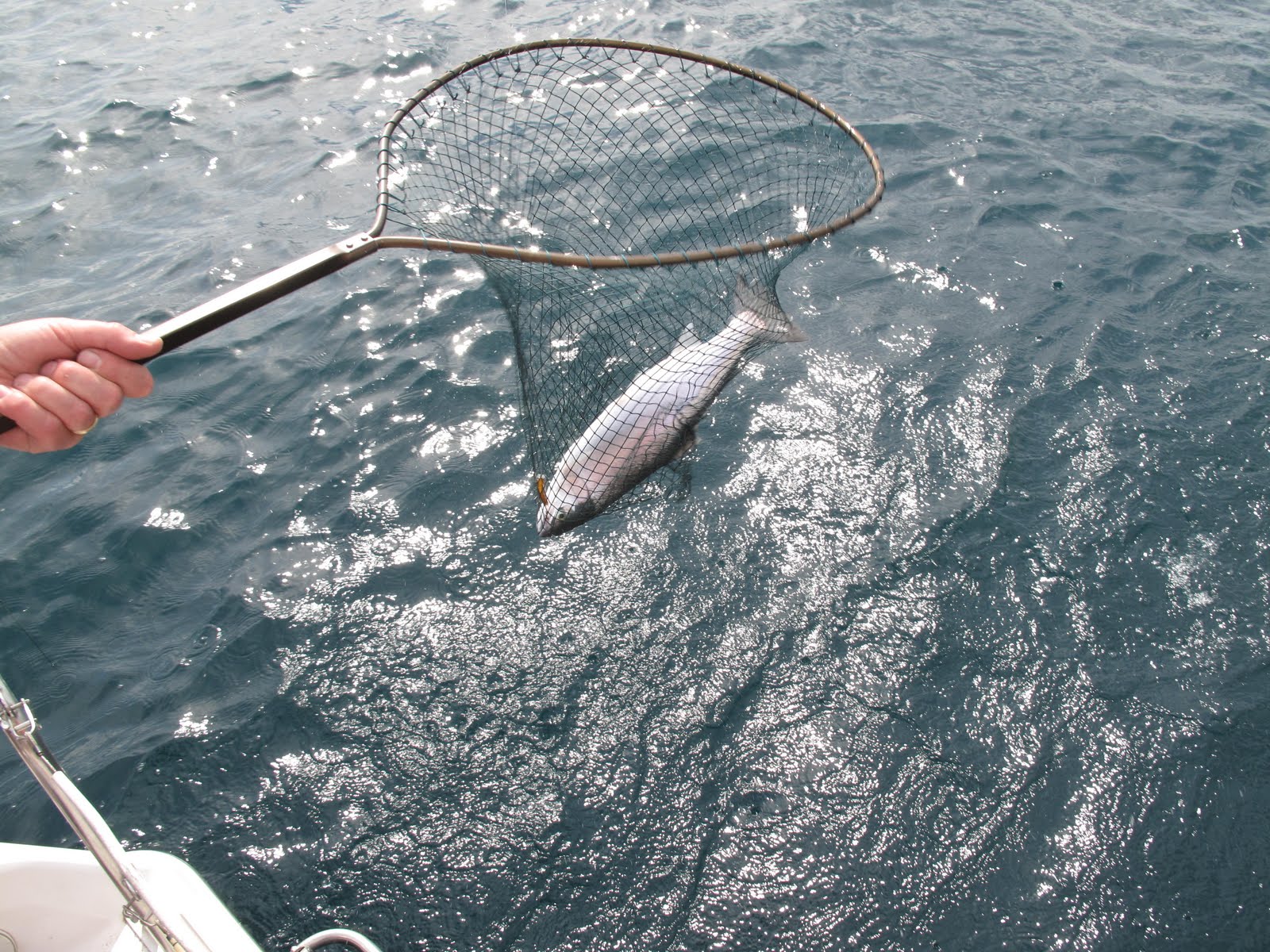
With a huge body of water conveniently located right in the centre of town, water activities feature quite prominently on the list of tourist attractions in Taupo, and for a not inconsiderable fee to cover boat rental and fishing licences, tourists can be taken out onto the lake to try their hand at fishing for trout. Lake Taupo is home to two species of trout, the rainbow trout and the less commonly seen brown trout, and, as both are closely related to salmon, they make for very good eating.


Serious anglers will not, however, find fishing on Lake Taupo much of a challenge - using sonar, the boat crew take you to spots where trout are in abundance, and they set up all the fishing rods (affixed to harnesses so that you don't even have to hold them), and all you really have to do is reel the catch in.


In all, we manage to catch two trout that were of regulation size, but we had to give one away since there was obviously no way were going to be able to eat them both.


After the catch has been netted, one of the crewmen kills the fish by striking its skull with a pair of pliers, before slipping it into a plastic box where the fish, if it isn't already dead, suffocates its way to a slow and agonising death - so really the pliers are kinder.


When your time is up, or when you've decided you've had enough, your fish are gutted, cleaned and placed in plastic bags. If you return to land before 4pm, there is a good chance that you can smoke any excess fish; otherwise, you'll just have to bring your catch to a local restaurant that is willing to cook it for you, which is not really that difficult, since my impression was that just about any restaurant in Taupo offered such a service. The one we chose was Plateau, a contemporary bar-restaurant close to the lake (so that we wouldn't have to travel far to drop off our fish), and close to our hotel (so that we could get back for a shower and return to the restaurant just in time for dinner). More importantly, it had also been rated as Taupo's top restaurant by TripAdvisor, so I had high expectations (I really, really did not want them to ruin the very fresh and expensive trout).


S's seared diver scallops were beautifully plump and golden, and artfully decorated with rocket leaves and asparagus shoots. The earthy, slightly bitter asparagus and rocket perfectly matched the buttery nuttiness of the scallops, which were firm and tasty.


I chose a quail dish, which involved a leg of quail that appeared to have undergone a poche-grille treatment, as it retained a bit of blush despite being brown on the outside and cooked through, and served in what I believe was a mushroom consomme containing both sliced shiitake mushrooms and mushroom tortellinis. Once again, it felt distinctively Asian, but it was an enjoyable, light appetiser nonetheless.


Of course, the trout was the main event, and the restaurant certainly did justice to it: the trout had been stuffed with rosemary and lemon slices, and baked on a bed of zucchinis and celery. As if that weren't enough, it was also served with generous portions of mashed potato, which was some of the creamiest I've ever had. Although I'm not normally a big fan of fish, the trout was so fresh that it was impossible not to enjoy this. The flesh of the trout was salmon-pink, and so delicately smooth that there was barely a need to chew, and the melange of vegetables not only provided a brilliant colour contrast, but also tasted fantastic.


Alas, although our efforts were valiant, it was simply impossible for us to finish the entire fish.


However, as there is always space for dessert, we decided to share a white chocolate and vanilla panna cotta, which was a little too firm as a result of the white chocolate, and I thought the strawberry sauce was too syrupy, but otherwise a sweet ending to a staggeringly filling meal.

I was very definitely pleased with the food Plateau had to offer, and thought that it in fact was probably one of the best restaurants of the entire trip (together with the French Cafe), although I was only able to regain consciousness the next day.


Plateau
64 Tuwharetoa Street
Taupo 3330
Tel: +64 07 377 2425
Website


Day 7: Auckland

Dinner

Sadly, we'd come to the end of our journey, and, after braving an incredible three-hour traffic jam, it was time for one last meal in Auckland (technically there was breakfast the following day before our flight, but that doesn't really count), and I had already secured a reservation at Cibo, a trendy restaurant which was clearly the place to be seen on a Friday evening, because the restaurant was absolutely packed.

I was somewhat concerned when I noticed that many of the waiters were dressed in what floral shirts, sporting horned-rimmed glasses and pointed shoes. I have nothing against fashion sense per se, but I hoped that Cibo wasn't simply all style and no substance.


With a dish like "New Age gazpacho with stuffed baby vine tomatoes pickled spanner crab roasted garlic pannacotta and tomato essence", one can see why there was cause for worry. The dish was as pretentious as it sounded, with a number of discrete ingredients each vying for attention in a discordant cacophony of colours and tastes. It was not, of course, a bad dish; the baby tomato stuffed with spanner crab and the tomato essence, were actually quite nice, although I was rather less fond of the garlic panna cotta. The main problem, however, was that the separate components of the dish simply did not deliver a composite whole.


S fared better with her starter, though, which was a black sesame crusted tuna with crispy shredded duck and cashew nut salad palm with sugar dressing, although she did note that she could not taste the duck in the salad.


My main course was a char-grilled Angus pure eye fillet with red wine braised ox cheeks and a beetroot relish gremolata, which sounded pretty delectable, and indeed, the red wine braised ox cheeks were meltingly delicious, with a intense flavour of beef and red wine. Unfortunately, the restaurant had overcooked my fillet, and I was not at all impressed that one of the floral-shirted waiters attempted to convince me that this was because I had chosen to eat my beef cheeks first. He did, however, have the decency to concede that even if the beef continued cooking while it sat on my plate, it ought not to have been that overcooked, and I was given a new, properly-cooked steak within a short time, with no less than two apologies.


Sauteed prawns with caprino and chervil tortellini, served with toasted pinenuts and golden raisin butter with shaved pecorino were S's choice of main course (technically a starter, but she requested for a main course portion), and, notwithstanding the elaborate list of ingredients, looked like a very enjoyable and technically competent dish.


For dessert, we settled upon a compressed Valrhona cocoa with chocolate sorbet, milk chocolate mayo, sesame toffee and nut crisp. An elegant dessert, this was easy to enjoy, and we polished it off in fairly short order.

Cibo
91 St George's Bay Road
Parnell
Website
Tel: +64 09 303 9660

Review: Artichoke


My reigning favourite cafe is a place called Cumulus in Melbourne, a gorgeous and stylish, tucked-away little place that churns out new, good food and brilliant eating experiences each time I'm there. Over time, I've come to realize that there really is a gold standard for good restaurants and good food, it all really Feels the same.

I can always tell because I feel inspired, while eating, I start thinking of recipes that would really work in and for the particular restaurant, or savour flavours that I can't wait to try out at home. Cumulus made me buy a mandoline and slice fennel like never before, frying it lightly with green olive oil and orange. Good food makes me feel, like cooking and like eating, no matter what day or week it is.

A mark of a good restaurant is also when, no matter what comes before and after, I leave feeling like the day just became better. No matter what the price point, the best of restaurant experiences, like Momofuku Ko in New York and Solociccio in Panzano, Tuscany, are when I leave dancing a little jig in my heart and hearing springs of jazz tunes. The best restaurants have the culinary equivalent of a Disneyworld je ne se qois, they make people feel... happy.


Just the other night, I went to just such a restaurant and I think this place, indeed, the chef, will not remain unnoticed for long. I'd love to say that I'm very plugged in to Singapore's eating scene but in truth, I entirely chanced upon this place, having seen a Facebook update by Yuan Oeij of Prive. I tracked down the restaurant Artichoke and found that it was in Sculpture Square, by the junction of Waterloo and Bencoolen street, in the shadow of an old orange, yes orange, chapel.


This square and chapel have been modified into buildings that house workshops and studios for 3D animation and art exhibitions and the garrison structure of the church and cobblestoned yard have been well-preserved.

I'm a sucker for beautiful names (how evocative is Sculpture Square?), purposeful Conservation buildings and restaurants that have the motto "We believe real cooks make real food with their own hands. Artichoke’s team epitomise this ideal, making our own fresh cheese, butter, pickles, condiments, sausages, cured meats and fish, baked goods and pastries in-house." What this means in restaurant lingo, is that I knew without even asking, that this place was run by a chef-owner. I called up and was given the last available late table for dinner that same evening- score!


The restaurant was kitted out in the cafe style that has become du jour, funky flooring, Ikea faux vintage lights, wood tables and I swear the Salvation Army must be running out of mismatched chairs. (I don't mean this in a mean way, my home and the living room from where I'm typing this, could be described in very similar vein). I noticed a few unusual things when I walked into the restaurant, one was the use of dukkah, which could have been attributed to the menu's somewhat Moorish leanings but which I associate far more with Australian cooking.


The second was the presence of three large tables of Caucasians or asian girls with white guys. I was surprised, the expat crowd in Singapore is notorious for supporting their own when it comes to food, even dodgy Italian joints employing entire families, so this is quite an achievement for a local chef. Then I realized what it was- while the earlier prejudice is true, what expats are also really good at, is sussing out a good value deal. And, this restaurant definitely was, mains averaged $26 and $56 for a shared plate for 2 or family-style, while desserts were $10, this in the center of town and with a convival, comfortable atmosphere. Hard to find.


I realized a third reason later on in the meal, which is that the food is actually very authentic. Having spent some time living in London with a Lebanese roommate, I am particularly picky about babaganoush, amongst other Middle Eastern dips. It is rarely ever fresh, tart and wholesome in Singapore but it was here.

They were delicious and despite being, I thought, really full from Colin's rendition of Gordon Ramsey for lunch earlier in the day (more on this later), I polished off all the light, Turkish bread with dips before I was cognizant of how much I had eaten. They were really good, two days later, I was in a meeting in the middle of the day and started day-dreaming about tasting the blended chickpeas and smooth olive oil.


When our Kin Soon mushrooms arrived, I could tell that they were perfectly, turgidly fried, still succulent with all their woody, musky sweet juices. Then the Kurabuta pork chop came to the table, dusted in panko and topped with shaved fennel and I thought that between the single-origin produce, the way the mushrooms were cooked and the fennel, this was quite a unique offering for a local-helmed kitchen.


Having been fortunate enough to catch Bjorn Shen as we left, I learned that he had been in Sydney and Brisbane before returning to Singapore and while he had been in chef whites, he'd spent the last few years in academia, teaching marketing. Bjorn is one of those playful, shaved-headed grill cooks (in Singapore, this is known as an ACS guy), very much like Engsu Lee of Peguin vs Crow, who is as irreverent and humorous as his food. After dinner, we were given a scrunched up brown bag and in it, we found three sour gummies. I'm not sure if this is entirely clever marketing (you know, I would have preferred a brown-bagged pair of macarons) but I did eat two on the way to the car and thought, boy but it's been a long time since I've had a sour gummy.


Remember his name, because although it is advertised as Moorish, the food really reminded me of the best of modern Australian like Ezard or Lotus and it lends itself to so many different directions and influences, that it's very exciting. It was unpretentious, it was honest and it concentrated on fresh, local produce which gave a real kick to the taste and flavour of the food. Unlike Bistro Soori, where I could identify the "borrowed" elements from at least six different brand-name restaurants in the appetizers, or Andre, where there was a little bit of trying for the sake of being creative-different (and bear in mind, I liked both of these restaurants), Artichoke really is simple and yet innovative at the same time, it is much more down-home an experience.


Like all new start-ups, there are areas for improvement in Artichoke, one is the service, which was patchy. We had to ask our server, what the specials on the board were and then he thought to tell us that three were already unavailable.

The menu is still fairly tight, particularly in desserts, where they don't yet seem to have a dedicated dessert chef and could use more feminine choices of lighter citrus desserts to cut through the fairly rich appetizers and mains. (We had the pear and almond cake with sweet cream and the date pudding with smoked milk custard, salted caramel and peanut crumble, the former was good, the latter outstanding and would have been even more so if the milk had been more chilled, ala a Tres Leches cake).


There are also some logistically odd dishes, like one special of Stolen lamb, a roast which takes 30-40 minutes to cook. Unless that is advertised to customers over the phone bookings ala Cocotte's signature roast chicken, I'm not sure how many would like to wait that long to get the meal. Lastly, I've also been told that brunch here on the weekends is more ordinary, with the usual mill-run eggs and bread-like cakes. Having seen tonight's dinner menu, I would assume that brunch would also have similar twists and turns in culinary combinations but I guess that remains to be seen. Overall, these are a very small price for the excellent experience we had. I'm already looking forward to going back with a bigger group for the twice-cooked lamb and pork belly with scallops, so look out for a more comprehensive review. I don't often say this, but this place is really, really good.

Artichoke
161 Middle Road @ Waterloo Road, Sculpture Square
Tel: +65 6336 6949
www.artichoke.com.sg
Opening Hours
Tue–Thu: 12pm – 10pm
Fri–Sat: 11am – 12am
Sun: 11am – 4pm
Park at Waterloo Central or NAFA carparks