Saturday, June 25, 2011

Review: Gaia


A new Italian restaurant has recently opened its doors at the Goodwood Park Hotel, that beautiful grand old dame of colonialism on Scotts Road.


Named Gaia, for the earth (which, incidentally, being Greek, is a rather strange name for an Italian eatery), it is one of the latest residents to occupy the side of the hotel facing the carpark as you enter from Scotts Road (previous denizens being Thumper and Bice), and is run by the same good people behind Oso Ristorante, who are clearly in expansion mode.


The interior of the restaurant, it must be said, is lovely. Upon entry, you are greeted by an arresting bar, before walking past a long corridor that fills you with an endless sense of space and comfort.


The dining room itself is no less charming; there is a good mix of classic dark woods, white tablecloths and impressionist artwork, contrasted against the more contemporary glass wine cellar (with private dining room).

Where it counted the most, however, I thought Gaia fell somewhat short. To be fair, I was only there for lunch and could only sample a set lunch menu, but if a restaurant cannot manage a set lunch that is a serious concern.


The carrot soup, to start, was too thick for my taste, and (what amounts to almost the same thing) not very well-blended: I could feel carrot bits being caught in my teeth, and I found a sliver of some onion skin as well. Despite the drops of chilli oil on its surface, this soup failed to excite.


The linguine vongole was cooked with tomatoes, which is not that common for the dish, but was, I thought, a worthwhile addition, for the linguine took on a more complex character with a sunny, fresh sweetness. Unfortunately, as my father observed darkly, the meat of the clams fell away from the shells rather too easily, which was, he said, normally a symptom of lack of freshness.


Dessert was a multi-layered chocolate mousse with almond toast - a very pretty affair that was also a little difficult to eat with a spoon, because the mousse offered so little by way of resistance. The mousse was enjoyable enough, though I would have preferred the chocolate somewhat darker.

Overall, I was a little disappointed with what Gaia had to offer, although to be fair there is only so much that can be on display during a set lunch. Perhaps, as with any new restaurant, Gaia requires a little more time to truly find its feet, but until then, I will probably be sticking to Gordon Grill when I'm at Goodwood Park Hotel.

Gaia
22 Scotts Road
Goodwood Park Hotel
Tel: +65 6735 9937
Website

Monday, June 06, 2011

Miscellaneous Food: A Morning in Harriann's Delights


Trays of gula meleka kueh kosui squares, dusted with dessicated coconut and ready to eat

I have some really exciting and delicious pictures to share. My friend Sharon gave me a creative and generous birthday present, I was allowed to spend a morning with the chefs at her family's three-generation kueh kitchen. The definition of "kueh" in the dictionary reads: (Cookery) (functioning as singular or plural) (in Malaysia) any cake of Malay, Chinese, or Indian origin, which isn't particularly helpful. I would instead say that "kueh" refers to a multitude of traditional desserts or sweets, made most typically from tropical pastes like green bean, mung bean, peanut, coconut or gula melaka (palm sugar) and baked, but most often steamed, in skins of rice flour, sweet potato or a similar carbohydrate-based dough.
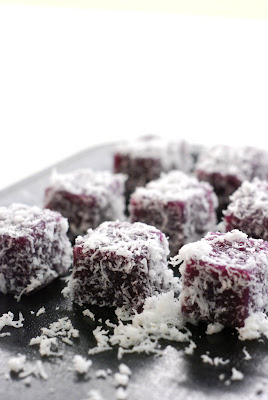

These kueh keledik are made from seasonal purple sweet potatoes, instead of regular orange sweet potatoes (the name for both sweet potato based kueh is the same). These were a big hit with their unique colour and piquant flavour.


Trays of kueh, sliced and whole, waiting for sale

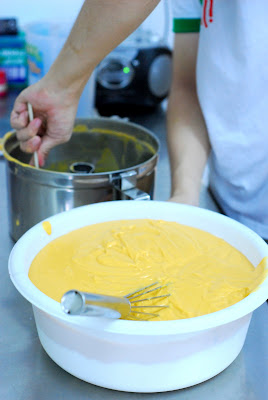
The process of making kueh is extremely tiring and time-consuming. In fact, it really is a dying art as few places make these sweets in a home-made and wholesome way. Certainly, the well-known commercial stores (as evidenced by their ingredient lists) do not. Harriann's Delights, still makes all their kueh in the traditional way, with all-natural ingredients. The riot of colours that you see here are all from the ingredients themselves and everything is made fresh.


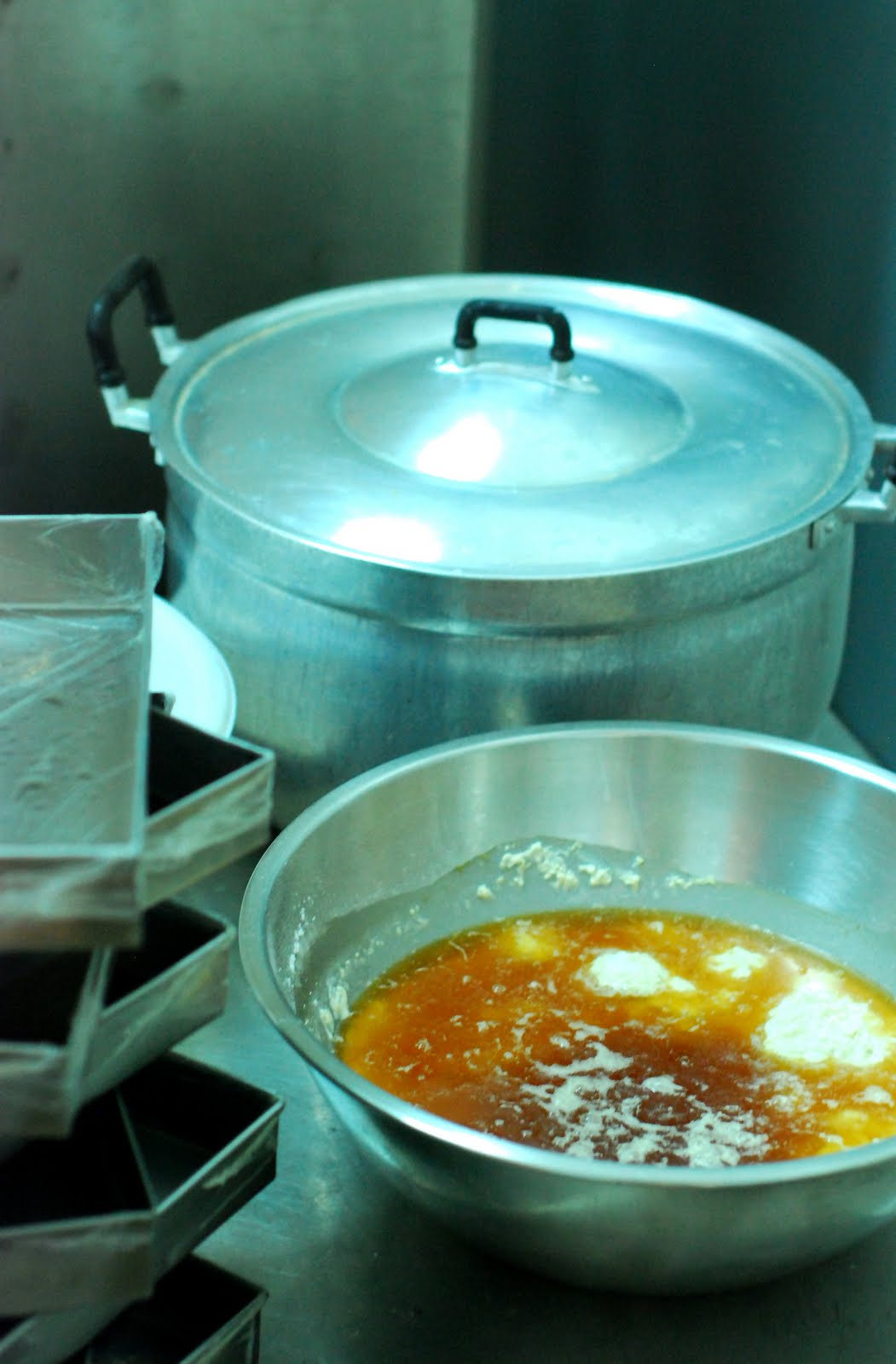
The implements of the trade


Grinding sweet potato into a puree, mixed with tapioca flour, for the kueh keledik

Although I was quite clear that working in commercial food operations is not easy, it wasn't till I was standing in the stiflingly steaming, bubbling kitchen, that I realized how daunting the heavy lifting, pouring, stirring, the mechanical, chemical action that goes into rendering kueh is and why most young people and home cooks wouldn't appreciate the hard work and scale of this Gargamel's lair. There was absolutely no worry that I could pinch recipes, most of the chefs had memorized the process and had simplified the proportions into large pack sizes.


Sharon looks remarkably cheerful for a bright and early Saturday morning.


Blending the rice flour and potato for ondeh ondeh

I myself love kueh, particularly ondeh-ondeh (balls of juicy, liquid gular meleka wrapped in thin potato flour skins, kueh dadar (gula melaka-drenched shaved coconut, wrapped in a thin pandan pancake) and kueh salat (a two-layered cake sandwiching a steamed coconut jam, known as kaya, against glutinous rice, stained at the fringe with the blue colouring from a tropical flower known as the bunga telang) but I am definitely one of the new-generation that don't dedicate myself to making kueh anywhere as often as I make Western dessert.
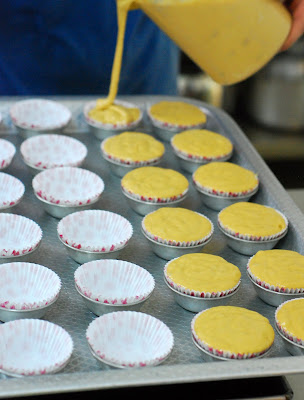

Pouring out the batter for huat kueh into papered moulds. Huat kueh (Hokkien) or fatt gou (Cantonese) translates as 'properity cake', "huat" meaning alternately 'to distribute', 'to explode- with reference to its cracked surface after steaming' or 'luck' and 'to strike riches'. These cakes are most often brown from gula meleka but also white or pink and decorated with a red dot when used for prayers during religious or New Year seasons.

Arriving at 8am, I had already missed the 3am shift to rice potatoes, grind palm sugar, sieve sugarcane juice and the like, for the morning sales at the wet market. These kitchen preparations were for their more modern store at Jalan Bukit Merah and moved at a slower pace, allowing Sharon and I to dabble in new ondeh-ondeh flavours toward the later morning. The chefs were really gracious, if a little amused in answering my many questions.


Waterchestnut kueh, made from cooking diced water chestnut with fresh sugarcane and water chestnut powder, then spread, cooled and sliced into fat squares.


A close-up of the waterchestnut kueh, I just love its verdant colour, springy texture and the cool refreshing sweetness of the sugarcane with the crunchy turgid chestnut pieces. I thought this would be a very adult kueh but strangely, children really warm to it.

Growing up in Singapore, I've been lazy about seeking out or appreciating kueh as often as other desserts. I'm also quite a terrible snob about kueh, refusing to fatten myself on pedestrain versions. Here's an example of what I mean- when making Kueh Salat, the kaya, or coconut jam, requires many hours of continous stirring by the stove to naturally thicken and smoothen the coconut, pandan and egg mixture. The commercial method is to introduce a thickener, like flour or gelatin.

The other common cheat is a big tablespoon of blue food colouring, which produces an inky, navy Smurf-esque colour, as opposed to the gentle cornflower blue of crushed bunga telong. The liquid food colouring will also have a messy application, as it inveriably seeps deep into the rice layer, leaving tell-tale patches and sometimes, a layer of soaked-soggy rice. Also, if the glutinous rice is hard or dry, it is a sign that the grains were not soaked overnight and froze up when cooked. I can't tell you how many of these I've been served, with insistences of "it's good, it's good!". The problem with sub-par kueh recipes is, it's just floury coconut on dried rice, steamed with blue food colouring- ain't no magic in that!


The trays of steamed kueh reminded me of those National Geographic photographs of clothing dye in India. These are kueh salat, yam, sweet potato and gula meleka kueh kosui.

I've often felt therefore, that the gap between good and average kueh is very discernible, unlike in Western desserts, where small fluctuations in texture are tolerable, even sometimes, negligable, given the heat and chemical reactions the baking process. They may make the difference between sublime and excellent but barring big flaws, as long as the cream is not sour, the sponge not collapsed and the chocolate not hydrogenated fats, the natural sweetness of most Western desserts covers up many flaws and satisfies the sugar high to end a meal. The variability of cakes allows them to be coarse, or fine, dense or aerated.

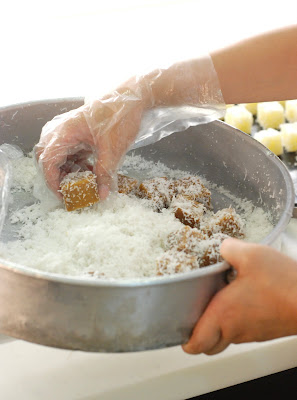

Tossing cubes of gula meleka kueh kosui in fresh, dessicated coconut.

The hallmark of kueh on the other hand, is refined consistency and the ingredients in kueh are very savoury. We all know what happens if potato is boiled too long, or inadequately steamed. A sub-standard kueh has a terrible and obvious mouth-feel, it is too hard, too thick or grainy or worse, too suddenly-crunchy or runny within. It tastes like it was stained by a sour streak of yesterday's curry gravy, or made with masses of ground horse-hoof powder. Somtimes I am convinced that it is this narrow margin of error, combined with the tediousness of the process, that has led to the decline of kueh's popularity amongst home-cooks and consumers.


Original ondeh-ondeh, dusted with fresh dessicated coconut. The store also makes chocolate ondeh-ondehs and durian ondeh-ondehs on special order.


These were the flavours that we experimented with, I made original gula meleka ondeh-ondeh, salted caramel ondeh-ondeh and ondeh filled with cheese (and raspberry cheese), then tossed in grated parmesan cheese. It isn't as easy as it looks to roll the fillings within the thin dough. Some of the ondeh-ondeh balls leaked when swirled in boiling water and we needed to use more solid paste or cheeses!

Thankfully, I've now been inspired and educated (not to mention hugely entertained) by my morning in the kueh kitchen and Sharon's family is holding the fort on this cultural food and remain dedicated to their craft. The Tans have been in this trade for the last two decades, prior to Harry and Ann’s involvement, the former’s mother, Madam Chia Ngak Eng, ran the stall at Tiong Bahru for more than forty years.


In the last decade, Madam Chia handed over the operation to Harry, which marked the birth of HarriAnn’s Delights. He has since adopted his mother’s traditional recipes and even improved some of them to cater to the palates of the modern customer, while remaining true to the standards of fresh ingredients, daily production, personal preparation and customer service.


The fruits of our labour, literally

Apart from kueh, they also make other authentic treats like glutinous rice with boiled peanuts and fried shallots, pumpkin and yam cakes and traditional new year cookies. What I really like about their product is that their prices, at $2 for 5 ondeh-ondeh, make it very reasonable to order a large tasting selection of kueh or party platters for guests. If you're interested in an order, call Sharon at 97492311.

Harriann's Delights
30 Seng Poh Road,
#02-25, Tiong Bahru Market
Open from:
Tuesdays to Sundays, 6am to 2pm

Blk 146, Jalan Bukit Merah #01-1092
Tel: +65 6273 0852
Fax: +65 6273 0825
Open from:
Tuesdays to Saturdays, 7am to 4pm
Sundays, 7am to 3pm
www.harrianns.com

Monday, May 30, 2011

Review: La Strada

Increasingly, I find very little reason to venture into Orchard Road. The profusion of concrete, glass and human throngs invariably means that it's one of the hottest places in this country, and, unless I have some reason to buy something from them, window-shopping at mall after mall seems rather soulless. Additionally, I have always felt that the Orchard Road district suffers from a disproportionate lack of good food, despite the crowds and spending power it attracts.

That is not, perhaps, quite true of Scotts Road, which has four restaurants owned by the Les Amis Group in a row. Of these, one of the cheapest is La Strada, a contemporary Italian restaurant that is Les Amis' way of expanding its market share out of high-end, refined food of the sort offered by its flagship restaurant as well as FiftyThree.


With its glass frontage, La Strada is brightly lit during the day, an advantage that is fully exploited by the white tablecloths and the wooden furniture. A good balance of starkness and naturalness - neither too uptight nor too casual.

As I spent some time waiting for my lunch companions, I had plenty of opportunity to sample the bread basket, which was fairly generous. In addition to grissini, the restaurant offers a number of varieties of bread, from foccacia to mini-baguettes. You risk, of course, eating too much bread, but that is your own affair.


Three course set lunches at La Strada aren't too expensive at $36, and you are given a wide selection at every course (although not a few of these come with a price supplement). The garden salad was a melange of ingredients, both exotic and quotidian: radish, red cabbage, tomatoes, pomegranate seeds and fresh greens. Laced with a tart dressing, it was both healthy and enjoyable.


My linguine al granchio was packed with flavour from the fresh mud crab flesh. The tomato sauce was not creamy, being white wine-based, and was therefore quite enlivening and piquant, given the chilli that had been added.


La Strada's linguine vongole was also deftly handled, which is rare for many restaurants, because the level of turnover is not always sufficient to ensure that the clams are fresh, and the white wine sauce is often watery and thin. At La Strada, however, not only were the clams scrupulously fresh and clean, they were also fairly numerous, and the white wine sauce had just the right balance between clam juice and white wine, properly reduced, so that it was rich and tasty, but also fresh and piquant.


My mother also enjoyed her main course of pan-fried fillet of barramundi with salsa verde and aceto balsamico, which was unsurprising, as the generous slab of fish, although simply presented, looked like it had been cooked perfectly.

La Strada has been around for a while, and under the stewardship of the Les Amis Group, it's easy to see why. It may not be the cheapest place to eat in Orchard Road, but it is probably one of the better ones. Service is friendly and well-trained, the set menu offers a considerable amount of variety, and the food itself is of a fairly high quality. So the next time you're out shopping in Orchard Road, why not plan an enjoyable meal at La Strada?

La Strada
1 Scotts Road
Te: +65 6737 2555

Monday, May 16, 2011

Recipe: Pandan Chiffon Cake


We are the featured recipe on the brilliant Notabilia's "Cooking with" series! P. is a transplated-to-Singapore teacher and writer, who has brought with her a keen sense and compassionate eye for all that is unique, artistic and fun in our little island. Her blog has a wonderful way of surprising me with the diversity that I should be better appreciating in my own home and I'm sure, if you're a dedicated Singaporean, that it will do the same for you. See the full post here.

"I have often teased Weylin, of Only Slightly Pretentious Food, pi-02-05-03 (a lifestyle blog), and dear friend, that she should quit her coporate-y day job and become Singapore’s answer to Martha Stewart. In her spare time, she cooks, decorates, flower arranges, designs, letterpresses, and crafts. Mark my words, “One day.”

Pandan chiffon cake is one of my favorite local treats. I’ve wasted many coins at Bengawan Solo, a local bakery, to cure my fix."

o o o o o

Pandan cake was ubiquitous when I was growing up in Singapore. I never liked the colour green in baked goods nor the strong taste of bottled pandan flavouring so, for years, I shunned it in stores and at parties. Then one day, a wonderful family friend and fellow baker made this cake, from a recipe that she claimed was augmented out of one of those thin, simple “Asian Baking” type paperbacks that you can buy near the check-out counters of NTUC.

The aroma of her home-made version lingered through the house and the warm, inviting, and dense fumes of coconut coming from the oven drew me immediately into the kitchen. I never knew that pandan cake could smell like this! I realized that the recipe really draws and benefits from the use of local produce but you must take the time to use fresh pandan and coconut milk. It might seem tedious to grind pandan leaves for essence but trust me, the cool, green, full-bodied, and fragrant taste is entirely worth it. This cake quickly became a favourite in my family too and is one of the few desserts that my mother and aunts, who can’t take a lot of (and anyway, dislike) rich cream cakes, really enjoy. It’s relatively healthy, very light, and a cake that really celebrates living in the tropics!

Pandan Chiffon Cake

Ingredients:
18 stalks pandan leaves
water
1 coconut, grated, or 300 ml coconut milk
9 egg whites
1/2 teaspoon cream of tartar
1 tablespoon caster sugar
8 egg yolks
160 grams caster sugar
150 grams cake flour
1/2 teaspoon baking powder
1/4 teaspoon salt

Method:
1. Make fresh pandan extract by blending the pandan leaves and a small amount of water (just enough to liquefy the pandan leaves) in a blender or a food processor. Make sure the pandan leaves are very finely ground. Strain the liquid and let it stand refrigerated, overnight.
2. The mixture will separate into two parts, water on the top and a thick, green juice that sinks to the bottom. This is the pandan extract and this recipe calls for 2 1/2 tablespoons of this juice. Gently pour away the water. If you have excess pandan essence, freeze it in ice cube trays for subsequent cakes.
3. Pre-heat the oven to 170 degrees Celsius.
4. Buy fresh grated coconut from a wet market (300 ml is about 1 coconut’s worth of milk) and extract the fresh coconut milk by squeezing it from the grated coconut. To extract the coconut milk, you have to add a little water to the ground coconut and then wring the damp coconut in a cheesecloth or towel. I gave the recipe to a friend who was wringing dry coconut until her helper said, “Mam, must add water first.” Only buy the fresh coconut on the day of baking, as it will not keep more than a day.
5. Beat the egg whites with cream of tartar and the tablespoon of caster sugar until stiff. You can omit the cream of tartar, as I do, but your cake will have larger air pockets, as the cream of tartar helps to bind the beaten egg white tightly together.
6. In a separate bowl, add the remaining 160 grams of caster sugar to the egg yolks and whisk. Add the coconut milk and the 2 1/2 tablespoon of pandan extract together, then add the cake flour, baking powder and salt.
7. Fold the egg white mixture into the egg yolk mixture gently and pour into a bundt pan. This recipe works best with a bundt pan to ensure that the chiffon rises and bakes evenly.
8. Bake the cake for 35 minutes, cool and slice the cake out of the pan with a thin bladed knife.
o o o o o

P. of Notabilia welcomes recipes from Singapore and beyond for her monthly "Cooking with…" column. Priority is given to original recipes that have not yet appeared online. Contact her at her blog if you have something to share!

Recipe: Strawberry and Rhubarb Pie


Here are the first of the Rhubarb photos. I decided to make three sweet desserts with the rhubarb, a strawberry rhubarb pie, a lemon and rhubard cake and rhubarb crumble ice cream. I've been reading about rhubarb since my earlier post last week and I now know that it's a relative of buckwheat and it is a traditional and Chinese medicine. In 1542, rhubarb sold for ten times the price of cinnamon in France and in 1657 rhubarb sold for over twice the price of opium in England.

Hothouse or strawberry rhubarb is sold from January and field-grown or cherry rhubarb is sold from March. I also learnt that the National University of Singapore studied the toxicological and anti-neoplastic potentials of the main anthraquinones from Rhubarb, so why isn't it sold here! Apparently only a quarter of rhubarb is sold fresh and the rest is sold frozen or for industrial purpose.


This pie is really easy to make and surprisingly delicious and comforting. I say surprisingly because rhubarb can be an acquired taste. If not well-stewed with sugar and lemon juice, it has a very vegetable-like, celeriac taste, with an open, slightly tangy and bitter note right at the end that doesn't always sit well with people, especially, as I discovered, young children. In this recipe though, the rhubarb cooks in its own juices and that of the strawberry, which helps to naturally sweeten and flavour the pie filling.


With the proliferation of blogs nowadays, I find it very rare that I turn to a paper cookbook anymore. How did we bake in the days before the internet? This recipe came from Smitten Kitchen and it is ridiculously, unthinkingly easy. You can use any pie dough recipe, either her butter flaky pie dough recipe or, as I like to use, Dorie Greenspan's perfect butter pie crust recipe from her book Paris Sweets (her crust incorporates ground hazlenut, which I feel gives it a bit more body and flavour). I always make a large quantity of dough, roll it out between parchment sheets and then roll them away and freeze them for sudden use. It's a godsend that these things can be frozen!


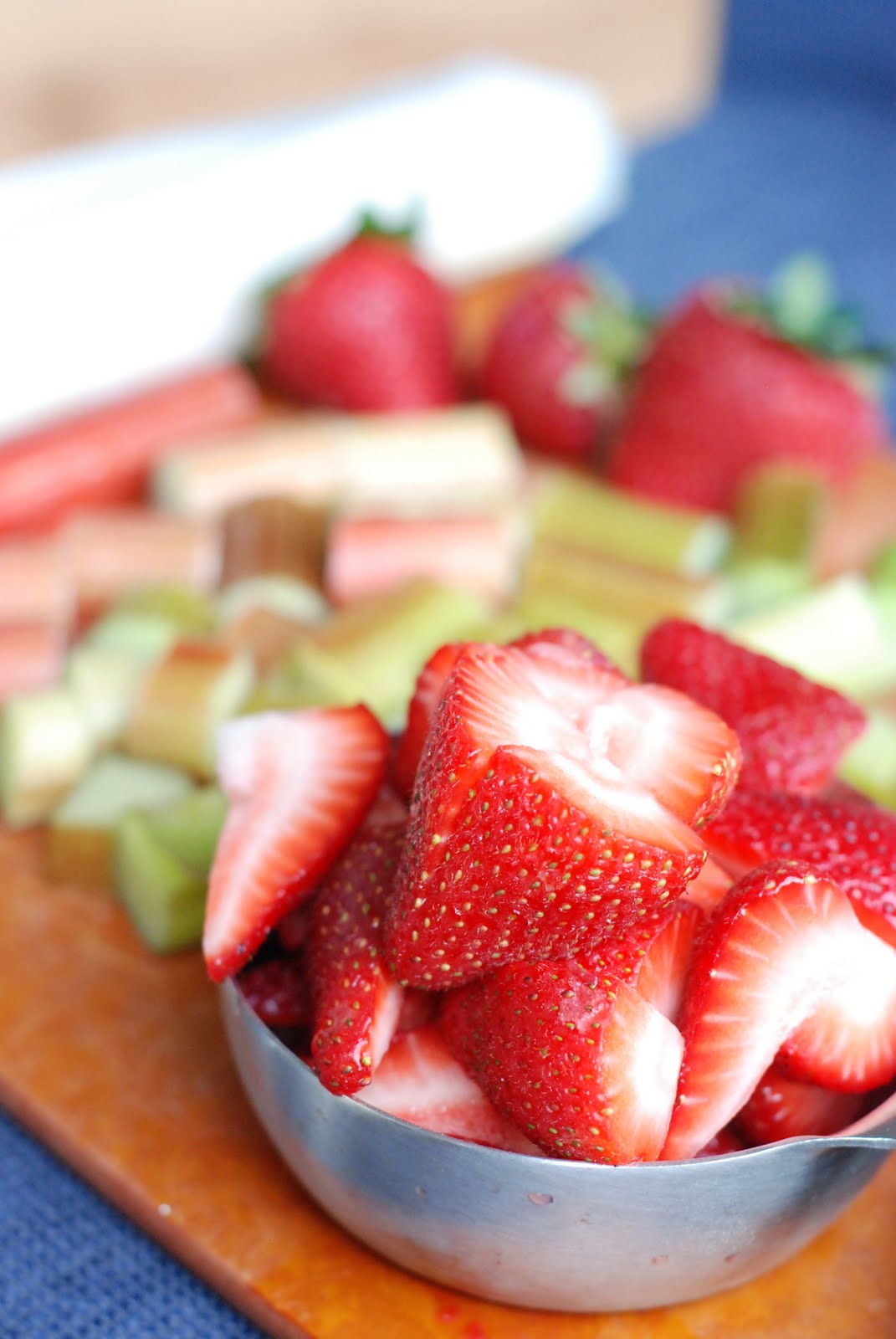
Roughly halve the strawberries (quarter, if they are large) and chop up the rhubarb. I left my fruit pieces fairly large, just slightly under an inch for the rhubarb, so that the filling would be more chunky. I used a large punnet of strawberries and 2 sticks of rhubarb. Toss them all in 1/2 a cup brown sugar, grate in a few slivers of lemon rind and add a 1/4 cup of fast-cooking tapioca.


I wasn't sure what this was, so I used tapioca flour and it turned out fine, essentially the tapioca is used to thicken, to produce that goopy smeary goodness that we know of as pie filling. While the fruit is macerating, bake the bottem half of the pie at 160 degrees C. It should be baked blind (weighed down by beans or pie weights) at first, then baked uncovered for another 5-10 minutes to a pale brown.


Pour the fruit in and slice up the remaining dough to make the lattice grid. When laying on the lattice, make sure to tuck the ends of the dough down against the sides of the pie base, I find using the new dough strips as tape at the sides helps to keep the pie together and the filling inside the caviy. While I was baking the pie, I realized that I didn't have a proper deep pie dish and had to improvise using a tart pan that was a bit too shallow.


Place the pie back in the oven, turn down the heat to 140 degrees C and bake for an hour or so, until the filling has thickened and the fruit is cooked through. You can brush the lattice with an egg yolk glaze or butter to make it brown and shiny. After baking, cool the pie throughly. This will help the filling, which may be a little runny when you remove the pie from the oven, harden slightly and set. Having used a tart pan, I set the pie on a plate while chilling, so that the filling wouldn't run all over my fridge!


Slice up the pie with a sharp knife, pushing all the way to the bottem when cutting. Serve in wedges with vanilla bean ice cream and mint leaves.